Gestion du Cycle de Vie des Contrats par IA : Comment les Entreprises Réduisent le Temps d'Examen de 90%
Par Delos Intelligence — 2026-08-07
Découvrez comment la gestion du cycle de vie des contrats par IA aide les entreprises à réduire le temps d'examen de 90%, à récupérer des millions en obligations manquées.
What Is AI-Powered Contract Lifecycle Management?
Contracts are the connective tissue of every enterprise. A mid-sized company manages 10,000 to 40,000 active contracts. Yet 71% still rely on manual review, spreadsheets, and shared drives.
AI-powered contract lifecycle management (CLM) applies NLP and ML across the entire contract lifecycle, cutting review times by 90%, recovering M in missed obligations, and transforming legal teams into proactive value drivers.
The core capabilities include:
- Clause extraction: Automatically identifying payment terms, liability caps, termination rights, IP ownership, and data protection provisions across thousands of contracts in minutes.
- Risk scoring: Flagging non-standard, high-risk, or missing clauses by comparing them against approved templates and historical outcomes.
- Obligation tracking: Extracting deliverables, deadlines, and SLAs and syncing them to task management and ERP systems.
- Renewal and expiry alerts: Automatically detecting renewal and termination windows and notifying stakeholders before deadlines pass.
- Search and analytics: Enabling natural-language queries across the entire contract repository.
!AI CLM workflow: from ingestion to renewal alerts
The Business Case: Why Enterprises Are Moving Now
According to World Commerce and Contracting, poor contract management costs enterprises 9% to 15% of annual revenue. For a 00M company, that is 5M to 5M leaking out every year.
The biggest leak is missed obligations. A typical enterprise contract contains 15 to 30 obligations: deliverables, reporting requirements, audit rights, payment milestones. When tracked manually, an estimated 40% go unfulfilled. At an average contract value of 50,000, even a 5% miss rate across 10,000 contracts translates to 25M in exposed value.
Enterprises that have implemented AI-driven contract analytics report:
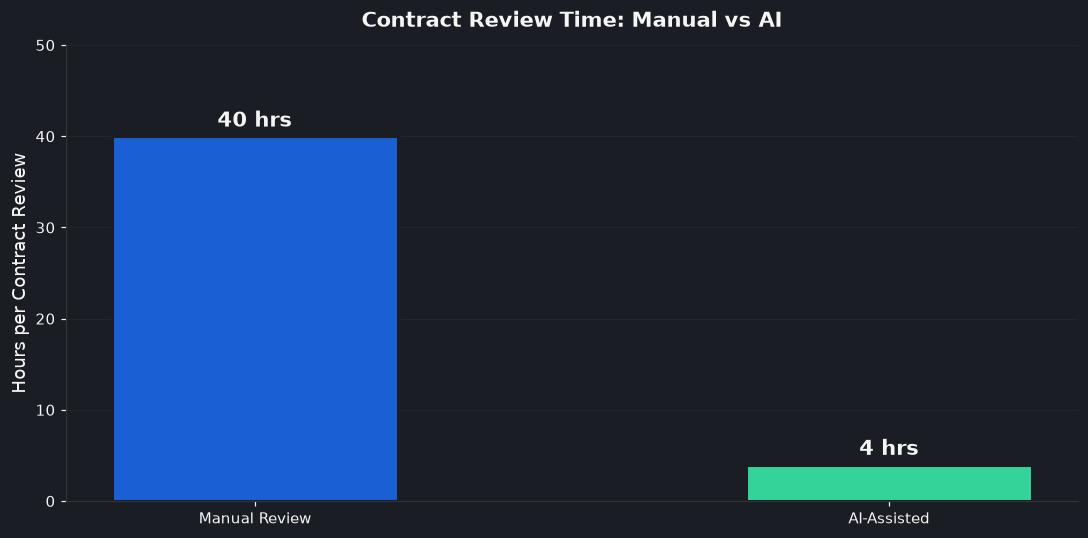
- 90% reduction in contract review time: What took 40 hours now takes 4 hours.
- M average recovery in missed obligations: Automated obligation tracking surfaces previously invisible deliverables and deadlines.
- 50% faster negotiation cycles: AI-generated redlines accelerate back-and-forth.
- 95% clause extraction accuracy: NLP models rival senior attorneys at a fraction of the cost.
How AI-Powered CLM Works: The Five-Stage Pipeline
Stage 1: Ingestion and Digitization
AI handles PDFs, scanned documents, Word files, and email threads. OCR converts scanned contracts into machine-readable text while NLP classifies each document by type: NDA, MSA, SOW, vendor agreement, employment contract.
Stage 2: Clause Extraction and Classification
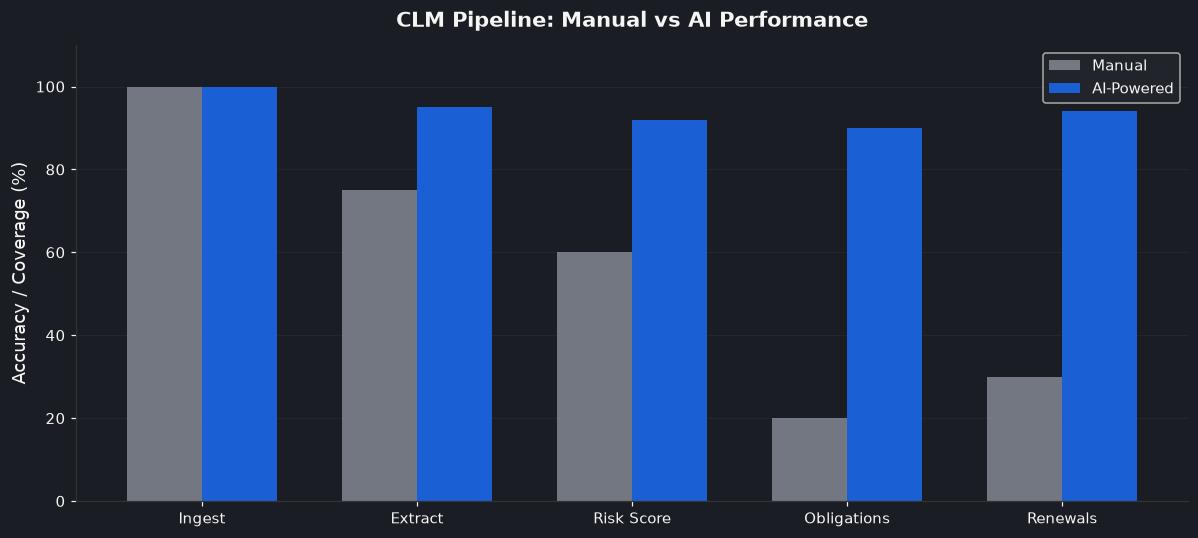
The AI reads each contract and extracts key clauses into structured data fields: payment terms, liability caps, indemnification, IP ownership, data protection, termination rights, force majeure. A human attorney reviewing a 50-page agreement needs 4 to 8 hours. An AI model does it in under 60 seconds with 90%+ accuracy.
Stage 3: Risk Scoring and Deviation Analysis
The AI compares extracted clauses against approved templates and risk policies, flagging deviations: uncapped liability where standard is M, GDPR-non-compliant data protection, payment terms exceeding 60-day windows. High-risk items route to senior attorneys. This triage reduces senior attorney review volume by 70%.
!CLM pipeline: manual vs AI performance by stage
Stage 4: Obligation Tracking and Performance Monitoring
AI extracts every obligation into a structured obligation register: who owes what, by when, with what acceptance criteria. These sync to project management tools, ERP systems, and compliance dashboards. Enterprises implementing automated obligation tracking typically recover 3% to 7% of contract value in the first year alone.
Stage 5: Renewal Intelligence and Strategic Insights
The AI identifies upcoming renewals, analyzes pricing trends, flags contracts with unfavorable terms for renegotiation, and benchmarks counterparty performance. For procurement teams, this means negotiating from data-backed strength. For finance teams, it means accurate forecasting of committed spend and contingent liabilities.
Implementation: What Enterprises Need to Get Right
Data Quality Is Non-Negotiable
Before implementing AI-powered CLM, consolidate your contract repository into a single accessible location. Migrate contracts from shared drives, email attachments, filing cabinets, and legacy CLM systems. Enterprises that skip the data cleanup step see extraction accuracy drop by 15 to 25 percentage points.
Start with High-Volume, Low-Complexity Contracts
NDAs, order forms, and standard vendor agreements are high-volume, low-complexity documents where AI delivers immediate ROI. Start there. Once models are trained on your contract landscape and the legal team trusts the system, expand to MSA, SOW, and complex partnership agreements.
Build a Feedback Loop
Every correction an attorney makes, every clause reclassification, every risk score adjustment should feed back into the model. Enterprises that implement structured feedback loops see extraction accuracy improve by 8 to 12 percentage points within six months.
Integrate with Existing Systems
AI-powered CLM delivers maximum value connected to systems your teams already use. ERP integration enables real-time spend tracking. CRM integration links contract terms to customer relationships. Procurement integration automates vendor onboarding. Without integrations, the AI becomes another silo.
Common Pitfalls to Avoid
1. Treating AI-powered CLM as an IT project. Contract management touches legal, procurement, finance, sales, and operations. Assign a cross-functional steering committee with clear KPIs from day one.
2. Over-automating high-stakes contracts. AI excels at first-pass review and risk flagging. High-stakes contracts (M&A, joint ventures, strategic partnerships) require human judgment. The right model: AI for triage, humans for judgment.
3. Ignoring change management. Attorneys who have spent careers reviewing contracts manually may resist AI workflows. Position AI as the tool that eliminates drudgery so attorneys can focus on negotiation strategy, risk assessment, and relationship management.
The Bottom Line
Contracts govern every dollar of enterprise revenue and expenditure. When managed manually, value leaks through missed obligations, expired deadlines, and unenforced terms. AI-powered CLM closes those leaks.
The enterprises that move first will recover millions in missed value, reduce legal spend by 30 to 50%, and build a contract infrastructure that scales without proportional headcount growth. If your enterprise manages more than 5,000 active contracts and still relies on spreadsheets and shared drives, the question is not whether to adopt AI-powered CLM, but how quickly you can implement it.
This article was produced with AI assistance in accordance with EU AI Act Article 50 transparency requirements.