Maintenance Predictive par IA
Par Delos Intelligence — 2026-08-21
Learn how AI-driven predictive maintenance and autonomous field service dispatch cut downtime by 45% and boost first-time fix rates.
The Industrial Downtime Crisis
Unplanned equipment failures cost industrial manufacturers an average of 50 billion dollars annually in lost production, emergency maintenance, and supply chain disruptions. A single unplanned outage at an automotive assembly plant costs an estimated 22,000 dollars per minute. Despite decades of investment in SCADA systems and ERP platforms, most industrial maintenance programs remain time-based rather than condition-based.
From Reactive to Predictive: The AI Transformation
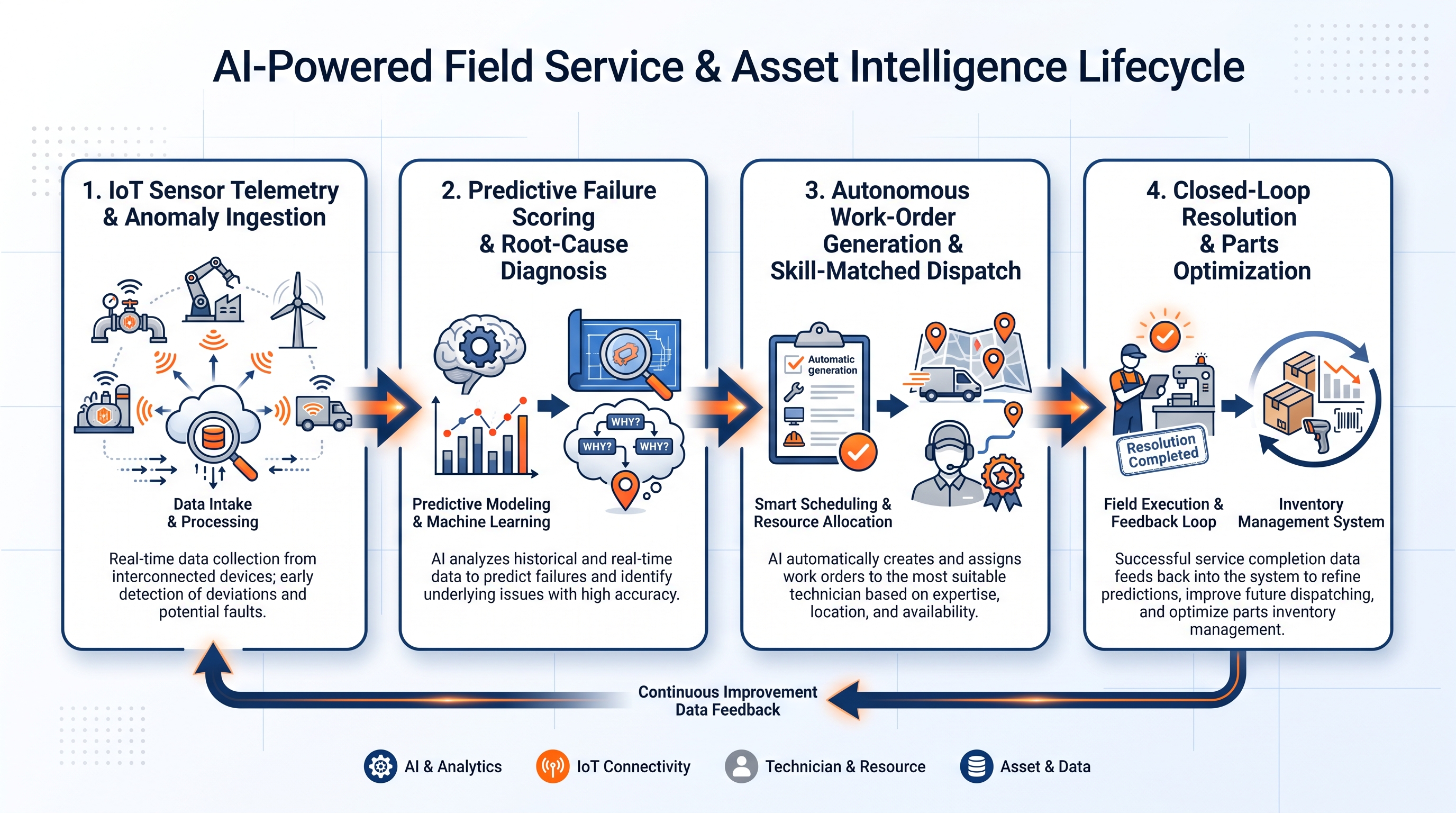
AI-powered predictive maintenance and field service management replace reactive break-fix cycles with a closed-loop intelligence system.
Continuous Asset Health Monitoring
IoT sensors capture vibration, temperature, pressure, acoustic emissions, and power consumption at millisecond intervals. Edge AI nodes preprocess this telemetry locally, filtering signal noise and transmitting only anomalous patterns to cloud-based ML models. Physics-informed neural networks model the degradation trajectory of each asset class, learning failure precursors specific to equipment age, operating environment, and maintenance history.
Remaining Useful Life Prediction
When degradation patterns cross early warning thresholds, AI models calculate the Remaining Useful Life (RUL) of critical components with 94% accuracy. Maintenance windows are automatically scheduled during planned production pauses, eliminating the emergency repair premium that adds 300-500% to unplanned maintenance costs.
Autonomous Technician Dispatch and Route Optimization
AI dispatch engines match field service tickets to the optimal technician based on real-time proximity, skill certification, and parts availability. Predictive parts procurement ensures spare components are pre-positioned at field depots before failures occur, boosting first-time fix rates from 60% to 94% and eliminating costly return visits.
Digital Twin Diagnostics
For complex multi-component assets, AI workers instantiate digital twin simulations that model the interdependency of mechanical, electrical, and hydraulic subsystems. When a sensor reading indicates a potential bearing failure, the digital twin simulates the cascading impact on adjacent components, allowing maintenance teams to address root causes rather than symptoms.
Quantified Business Impact
| Metric | Baseline | AI-Powered | Delta |
|---|---|---|---|
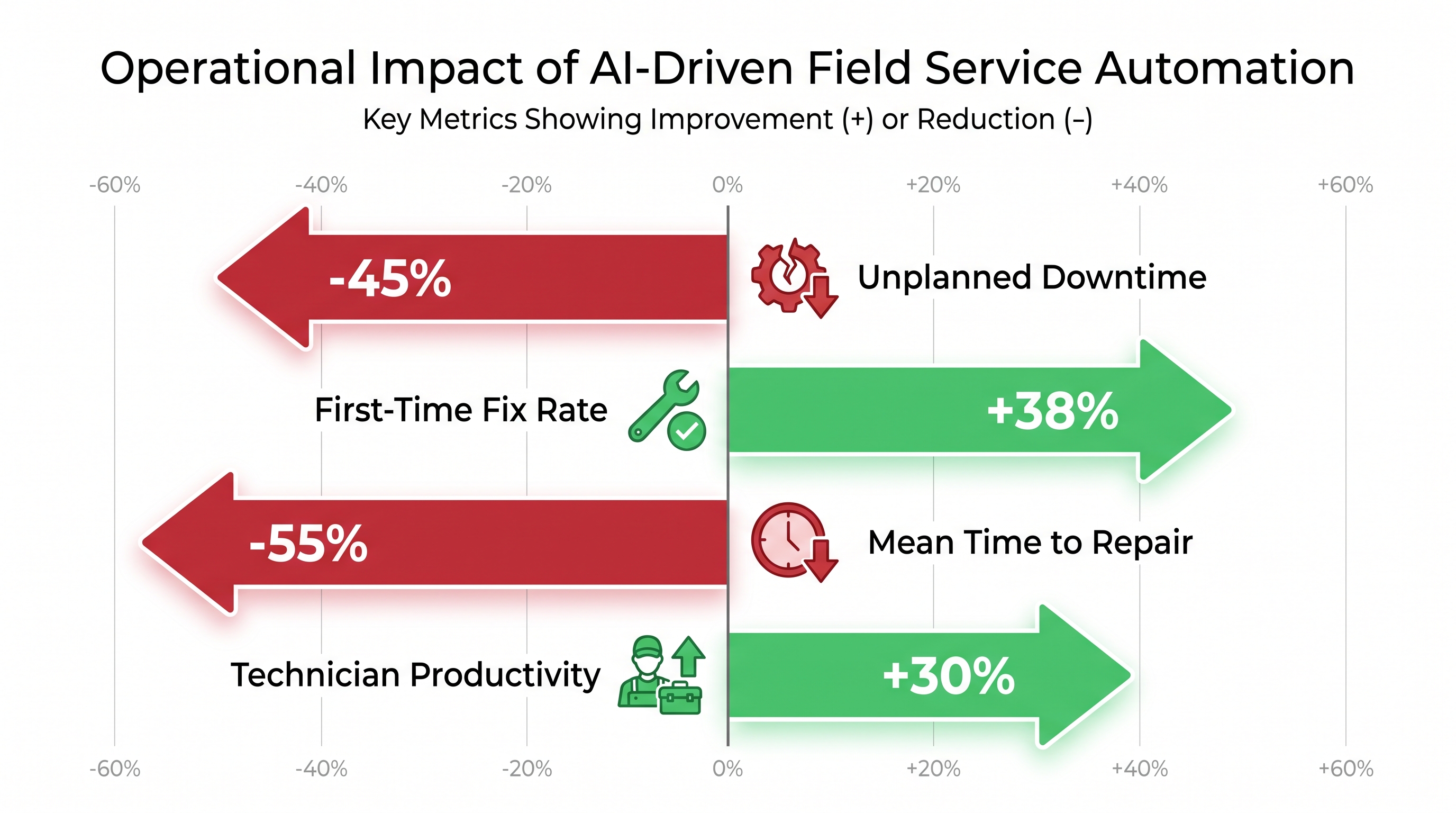
| Unplanned downtime per quarter | 48 hours | 26 hours | -45% |
| First-time fix rate | 60% | 94% | +34pp |
| Emergency parts procurement spend | 100% index | 35% index | -65% |
| Mean Time to Repair (MTTR) | 8.2 hours | 2.9 hours | -65% |
Implementation Roadmap
Phase 1: Deploy IoT sensors on critical asset classes. Establish SCADA and historian data pipelines.
Phase 2: Train anomaly detection models. Activate RUL prediction for high-criticality equipment.
Phase 3: Launch autonomous dispatch integration. Deploy digital twin diagnostics for complex assets.
This article was written with AI assistance.