Cloture Financiere par IA : Comment les Entreprises Reduisent la Cloture Mensuelle de 10 a 3 Jours
Par Delos Intelligence — 2026-08-14
La cloture mensuelle est la periode la plus stressante en finance d entreprise. L automatisation par IA reduit la duree de 60%, elimine la reconciliation manuelle et donne une visibilite en temps reel aux CFO.
The Month-End Close Crisis
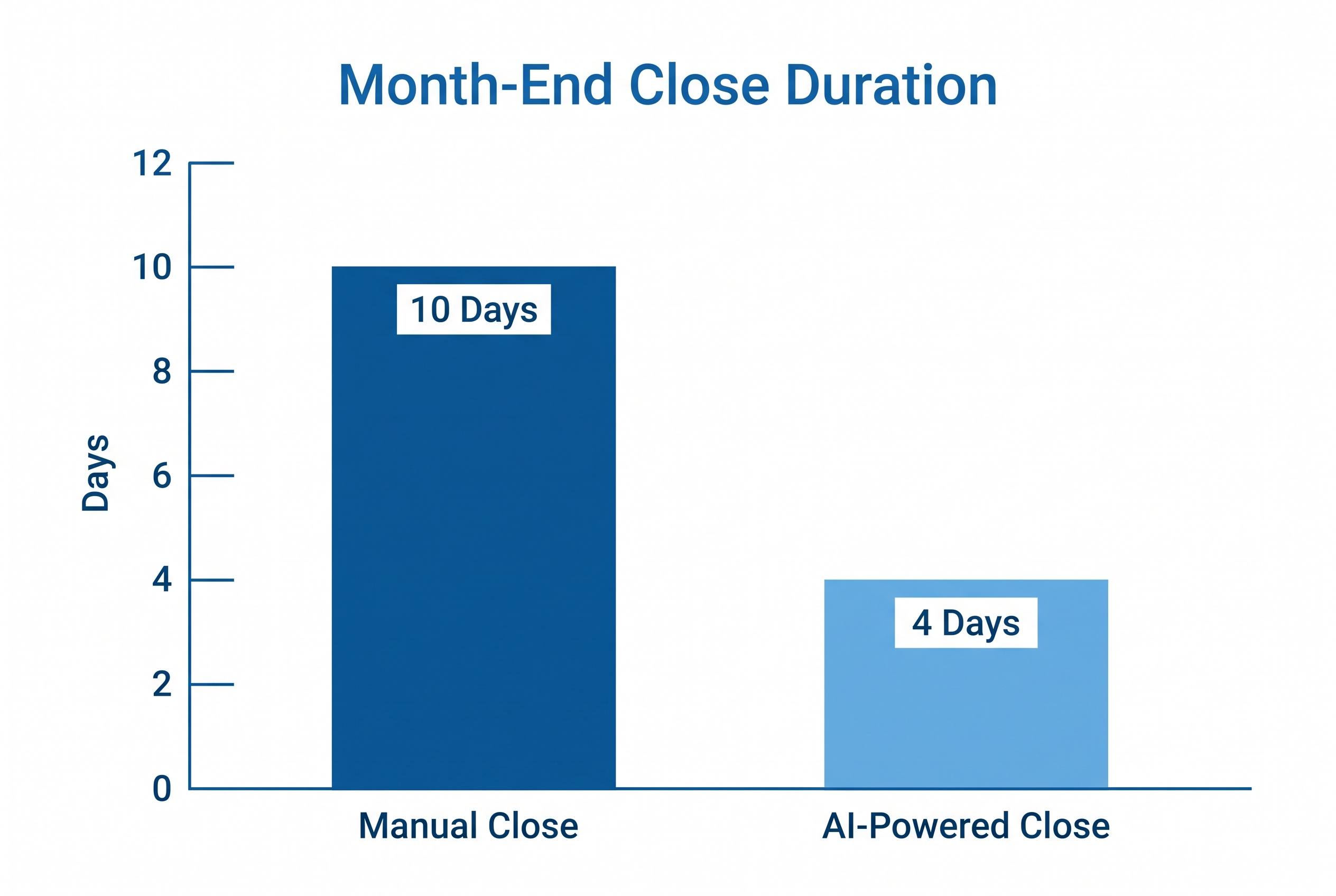
For most finance teams, month-end close is a grueling marathon. Controllers work late nights, accountants chase missing invoices, and CFOs wait anxiously for numbers that arrive days after the period ends. The average enterprise takes 10 days to close, with bottom-quartile companies taking 15 days or more (APQC research).
That delay has real consequences. Late closes mean late decisions. Investors lose confidence. Strategic opportunities slip away.
AI-powered financial close is changing this. By automating reconciliation, flagging anomalies in real time, and generating journal entries from transaction data, AI tools are helping enterprises close in 3 to 4 days instead of 10.
!Manual vs AI close duration comparison
What Is AI-Powered Financial Close?
AI-powered financial close uses machine learning and intelligent automation to streamline every step of the period-end close process:
- Automatically match transactions across bank statements, ERP records, and subledgers
- Detect anomalies and flag exceptions for human review
- Generate and post routine journal entries based on historical patterns
- Provide real-time dashboards showing close progress and outstanding tasks
- Use NLP to extract data from invoices, receipts, and contracts
How AI-Powered Financial Close Works
!AI financial close pipeline flowchart
1. Automated Data Collection and Reconciliation
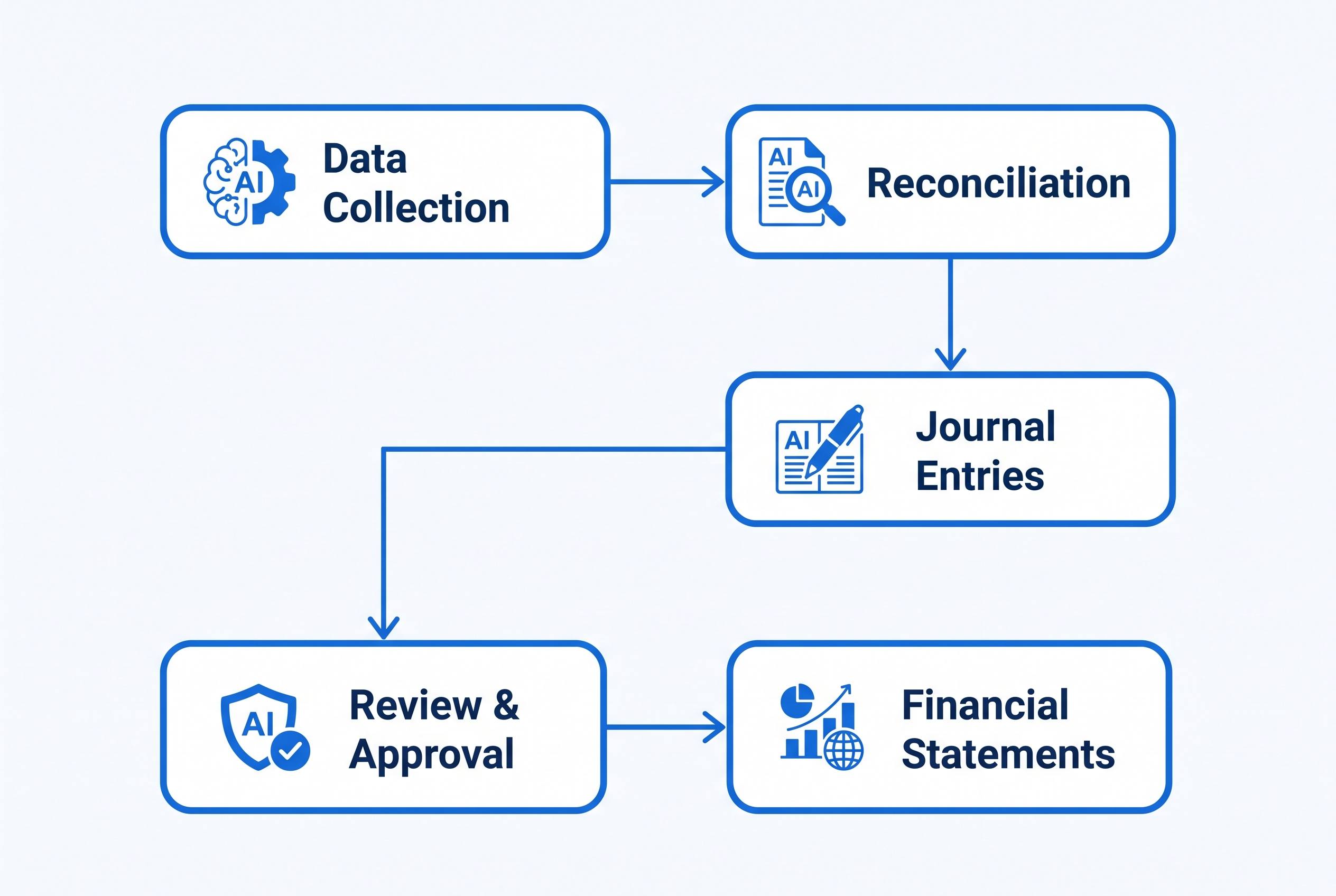
AI systems connect directly to bank feeds, ERP modules, and subledgers, pulling data in real time. Machine learning algorithms match transactions automatically, achieving 95%+ match rates without human intervention. What previously took 3 days of manual work completes in hours.
2. Intelligent Journal Entry Generation
Many journal entries follow predictable patterns: accruals, deferrals, depreciation, amortization. AI models learn these patterns from historical data and generate draft entries automatically. Controllers review only the exceptions, cutting manual entry time by 70%.
3. Anomaly Detection and Exception Management
Instead of reviewing every transaction, AI systems flag only outliers: unusual amounts, unexpected account combinations, missing documentation. This focuses human attention where it matters most and reduces review time by 80%.
4. Continuous Close and Real-Time Visibility
AI systems reconcile accounts continuously throughout the month. By the time the period closes, most accounts are already reconciled. CFOs get real-time visibility through dashboards that update automatically, transforming close from a sprint to a steady state.
The Business Case: Numbers That Matter
Enterprises implementing AI-powered financial close report measurable results:
- Close duration reduced by 60%: from 10 days to 3-4 days
- Reconciliation errors cut by 85%: automated matching eliminates manual transcription errors
- Finance team productivity up 40%: staff freed from repetitive tasks focus on analysis and strategy
- Audit readiness improved: AI maintains complete audit trails automatically
- Cost savings of $500K to $2M annually for mid-to-large enterprises (Gartner)
Real-World Implementation: What Works
Start with High-Volume, Low-Complexity Accounts
Bank reconciliations and intercompany transactions are ideal starting points. They are high-volume, rules-based, and easy to automate. Expand from there to revenue recognition and lease accounting.
Integrate with Your Existing ERP
AI financial close tools integrate with major ERP systems including SAP, Oracle, NetSuite, and Microsoft Dynamics. The AI layer sits on top of existing infrastructure via standard APIs. Learn more about AI document processing for handling unstructured financial documents.
Train Your Team, Do Not Replace Them
Controllers shift from data entry to exception management and strategic advisory. Pair this with AI compliance automation for end-to-end finance automation. See also how AI financial forecasting extends the impact beyond the close.
Common Pitfalls to Avoid
Boiling the ocean: Start with one or two processes and expand incrementally.
Ignoring data quality: Clean your chart of accounts and standardize coding before implementing automation.
Underestimating change management: Finance teams may resist automation. Communicate clearly that AI eliminates tasks, not people.
The Future of Financial Close
The trajectory is clear: within 5 years, continuous close will become the standard for large enterprises. According to McKinsey financial services research, AI-driven finance functions outperform peers by 20-30% on operational efficiency metrics.
Companies that adopt AI-powered close now will have a 2-3 year head start on competitors still relying on manual processes. For CFOs, the question is no longer whether to automate the close, but how quickly they can get there.
La redaction de cet article a ete assistee par IA.