Audit Interne IA : Comment les Entreprises Reduisent le Cycle d Audit de 80%
Par Delos Intelligence — 2026-08-05
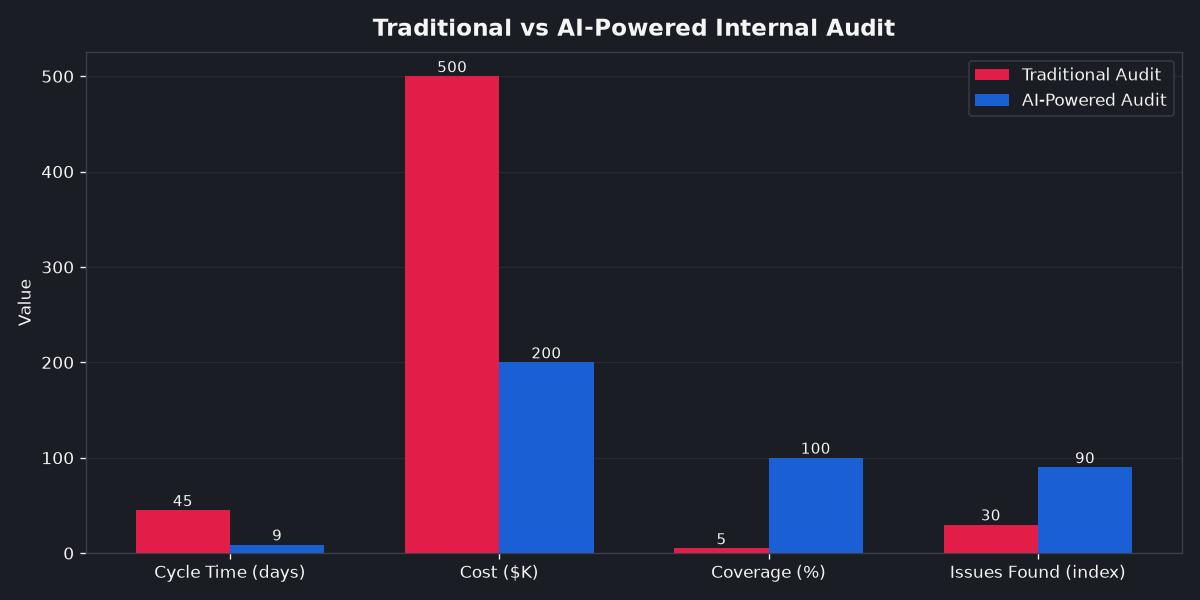
Internal audits consume 45 days and $500K per cycle on average. AI-powered audit automation cuts that to 9 days and $200K, while catching 3x more anomalies through continuous monitoring.
Why Internal Audit Is Broken (And Why AI Fixes It)
Internal audit is the backbone of enterprise risk management. Yet for most organizations, it is slow, expensive, and fundamentally reactive. A typical annual audit cycle takes 45 days, costs between $300K and $500K, and relies on sampling methods that examine less than 5% of total transactions.
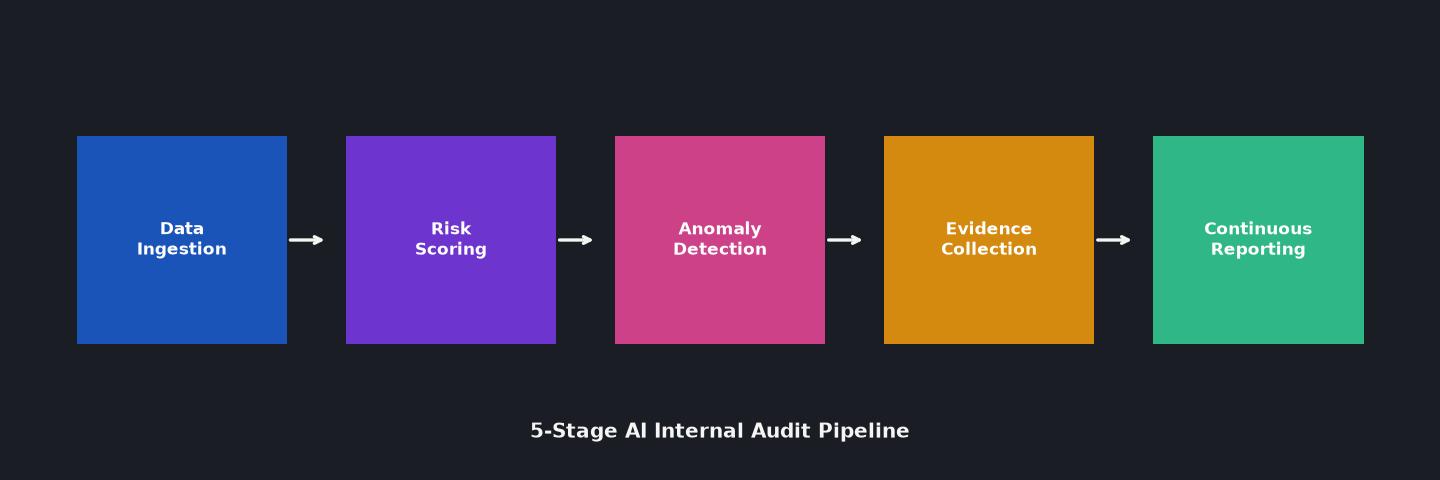
AI-powered internal audit changes this equation entirely. By automating data ingestion, risk scoring, anomaly detection, and evidence collection, enterprises are cutting audit cycle time by 80%, reducing costs by 60%, and shifting from periodic sampling to 100% transaction coverage.
The Numbers Behind Traditional Audit Inefficiency
A mid-size enterprise with 50,000 monthly transactions typically samples 2,500 of them (5%). The remaining 47,500 go unchecked. AI audit tools flip this ratio. Instead of sampling 5%, they analyze 100% of transactions in real time.
!Audit Cycle Time Comparison: 45 days traditional vs 9 days AI-powered
How AI-Powered Internal Audit Works: The 5-Stage Pipeline
AI internal audit is not a single tool but a pipeline of five connected stages:
!AI Internal Audit Pipeline: 5 stages from data ingestion to audit report
Stage 1: Automated Data Ingestion
The AI audit platform connects to enterprise systems (ERP, CRM, procurement, expense management, payroll) via APIs. It ingests structured and unstructured data continuously, eliminating manual exports and spreadsheet reconciliation. This alone eliminates 30-40% of auditor time spent on data gathering.
Stage 2: Risk Scoring and Prioritization
Machine learning models assign risk scores to every transaction, vendor, and journal entry. High-risk items are flagged for immediate review. Low-risk items pass through automatically. Auditors focus their attention on the top 1% of risk-flagged items, which typically contain 80% of actual issues.
Stage 3: Anomaly Detection and Pattern Recognition
AI detects anomalies that rule-based systems and human auditors miss: duplicate payment fraud, shell company indicators, unusual journal entries made outside business hours, and expense fraud patterns like threshold-dodging submissions. False positive rates typically drop from 40% in month one to under 10% after six months.
Stage 4: Automated Evidence Collection
When the system flags a high-risk transaction, it automatically pulls all related evidence: the original document, approval workflow, system logs, vendor master data, and payment record — organized into an audit-ready evidence package. What took 4-6 hours per finding now takes minutes.
Stage 5: Continuous Audit Reporting
Traditional audits produce a single report at the end of a 45-day cycle. AI audit platforms produce continuous, real-time reports. Audit committees access live dashboards showing risk trends, anomaly rates, and remediation status.
The Business Case: ROI of AI-Powered Internal Audit
Enterprises implementing AI-powered internal audit report:
- Audit cycle time: Reduced from 45 days to 9 days (80% reduction)
- Audit cost: Reduced from $500K to $200K per cycle (60% reduction)
- Transaction coverage: Increased from 5% sampling to 100% continuous monitoring
- Anomaly detection rate: 3x more issues identified
- Fraud recovery: Average $2.3M recovered in year one
- Auditor productivity: 5x increase in transactions reviewed per auditor
Implementation Roadmap
Phase 1 (Weeks 1-4): Connect to primary financial systems. Focus on the two or three systems containing 80% of transaction volume.
Phase 2 (Weeks 5-8): Run the AI platform in parallel with your existing audit process. Expect 30-40% false positive rates initially — watch them decline as models learn.
Phase 3 (Weeks 9-12): Conduct one full audit cycle using the AI platform. Compare findings with traditional audit results.
Phase 4 (Weeks 13-16): Roll out across all business units. Retrain auditors: their role shifts from manual data gathering to investigating AI-flagged risks.
Common Pitfalls to Avoid
- Treating AI audit as an IT project: Assign an audit leader, not an IT leader, as project owner
- Boiling the ocean: Start with accounts payable, expense management, and procurement — the highest-risk processes
- Ignoring false positive management: Build a structured feedback loop; every false positive is training data
The Bottom Line
Organizations still relying on manual sampling and 45-day audit cycles are flying blind for 11 months of the year. The enterprises leading this transformation have a continuous, real-time view of enterprise risk. The technology is mature, the ROI is proven, and the competitive risk of inaction grows every quarter.