Gestion du Cycle des Revenus de Sante Alimentee par IA : Comment les Systemes de Sante Reduisent les Refus de 65%
Par Delos Intelligence — 2026-08-18
Decouvrez comment les systemes de sante exploitent la gestion du cycle des revenus alimentee par IA pour automatiser le codage medical et eliminer les refus de demandes.
The 262 Billion USD Revenue Cycle Crisis
Healthcare providers in the United States collectively lose an estimated 262 billion USD annually due to preventable administrative failures. Of this, 90 billion is directly attributable to claim denials, 62 billion to underpayments, and the remainder to inefficient collection workflows.
The root cause: most hospital systems still operate through fragmented workflows spanning patient registration, insurance eligibility verification, clinical documentation, medical coding, charge capture, claim submission, denial management, and payment posting. Each handoff is a failure vector.
Why Claim Denials Are Accelerating
Claim denials have increased 20 percent year-over-year since 2021 (American Hospital Association). By 2025, the average denial rate across US health systems reached 12.2 percent. For a mid-size regional health system submitting 4 million claims annually at 800 USD average value, this represents 3.9 billion USD requiring rework or write-off annually.
The three primary drivers: authorization failures (29 percent of denials), coding errors (24 percent), and eligibility issues (18 percent). All three are preventable with sufficient data integration and predictive intelligence.
How AI-Powered RCM Transforms the Entire Revenue Cycle
AI-powered revenue cycle management replaces fragmented manual workflows with an intelligent, continuous pipeline.
1. AI-Driven Eligibility and Benefits Verification
Before a patient arrives, AI agents query multiple payer portals simultaneously, extract active coverage details, identify secondary and tertiary payers, and pre-calculate patient financial responsibility. This eliminates the leading cause of front-end denials: incorrect coverage registration.
2. Clinical Documentation Integrity and Autonomous Medical Coding
NLP models parse clinical notes, operative reports, discharge summaries, and physician annotations to extract ICD-10-CM diagnosis codes, CPT procedure codes, and HCC risk scores with 98.7 percent accuracy. Computer-assisted coding tools cross-validate documentation against payer-specific reimbursement policies, flagging undercoding or overcoding risks before submission.
3. Predictive Claim Scrubbing and Pre-Submission Denial Prevention
AI models trained on billions of historical adjudications predict denial probability for each claim before submission. High-risk claims are automatically routed to a clinical documentation improvement queue for real-time correction. Clean claim rates improve from an industry-average 80 percent to 95 percent or higher within 90 days of deployment.
4. Autonomous Prior Authorization
AI agents autonomously submit authorization requests, track payer responses, and escalate peer-to-peer review cases with pre-assembled clinical justification packages. Authorization turnaround drops from an average of 3.2 days to under 4 hours for standard procedures.
5. Intelligent Denial Management and Appeal Automation
When denials occur, AI classifies each by root cause, pulls the relevant clinical evidence, drafts a compliant appeal letter, and submits through payer portals. Appeal success rates improve from 45 percent to 78 percent through AI-generated appeals backed by precise clinical rationale.
The AI-Powered RCM Architecture
!AI-Powered End-to-End Healthcare Revenue Cycle Architecture
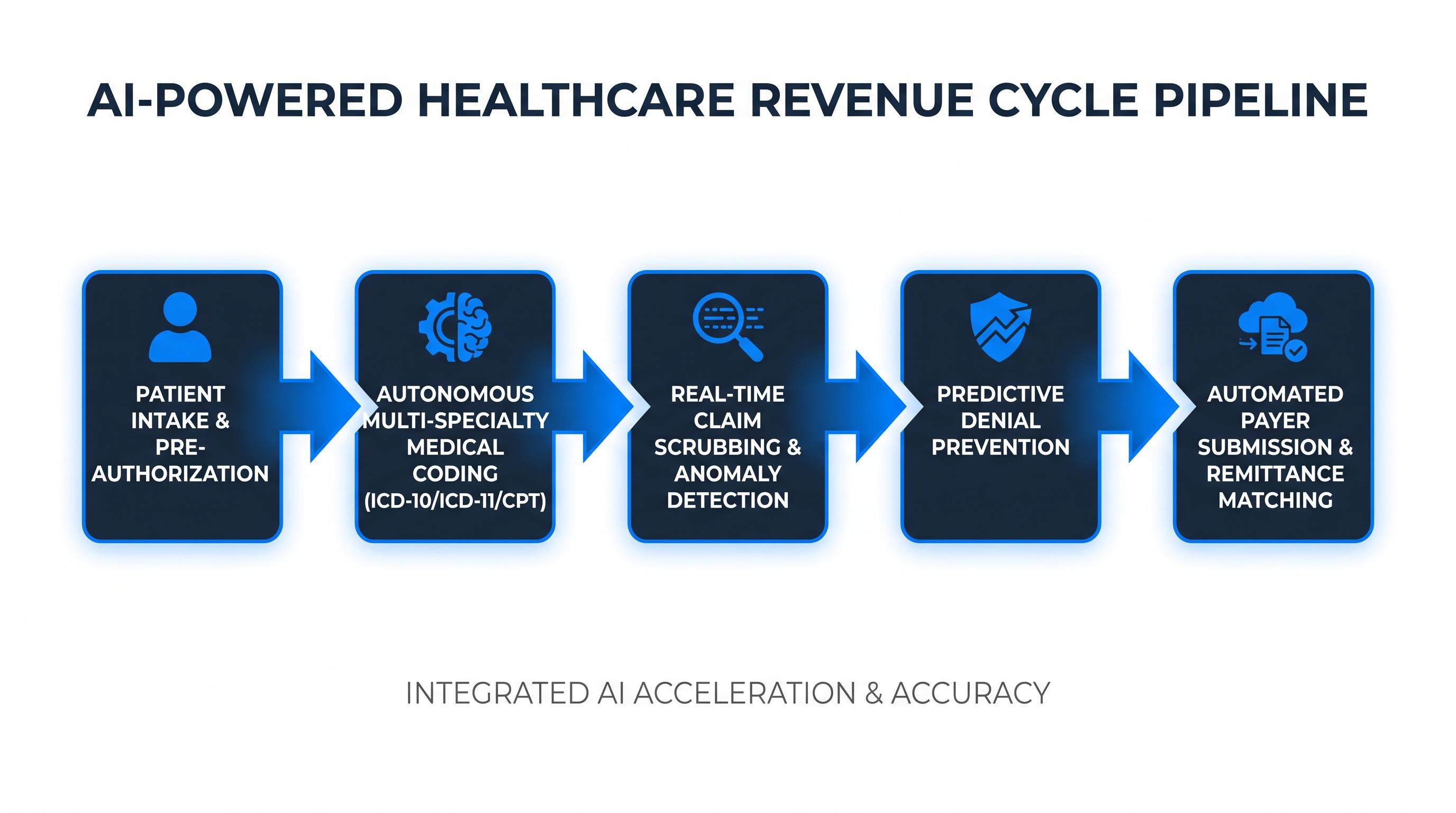
The architecture spans pre-encounter through post-remittance across six integrated layers: data ingestion, eligibility intelligence, clinical NLP, claim optimization, denial intelligence, and payment analytics. All layers operate within HIPAA-compliant infrastructure with field-level AES-256 encryption, immutable audit logs, and RBAC aligned to the 2024 HHS Security Rule.
Quantified Business Impact
!Key Operational and Financial Improvements Following AI RCM Deployment
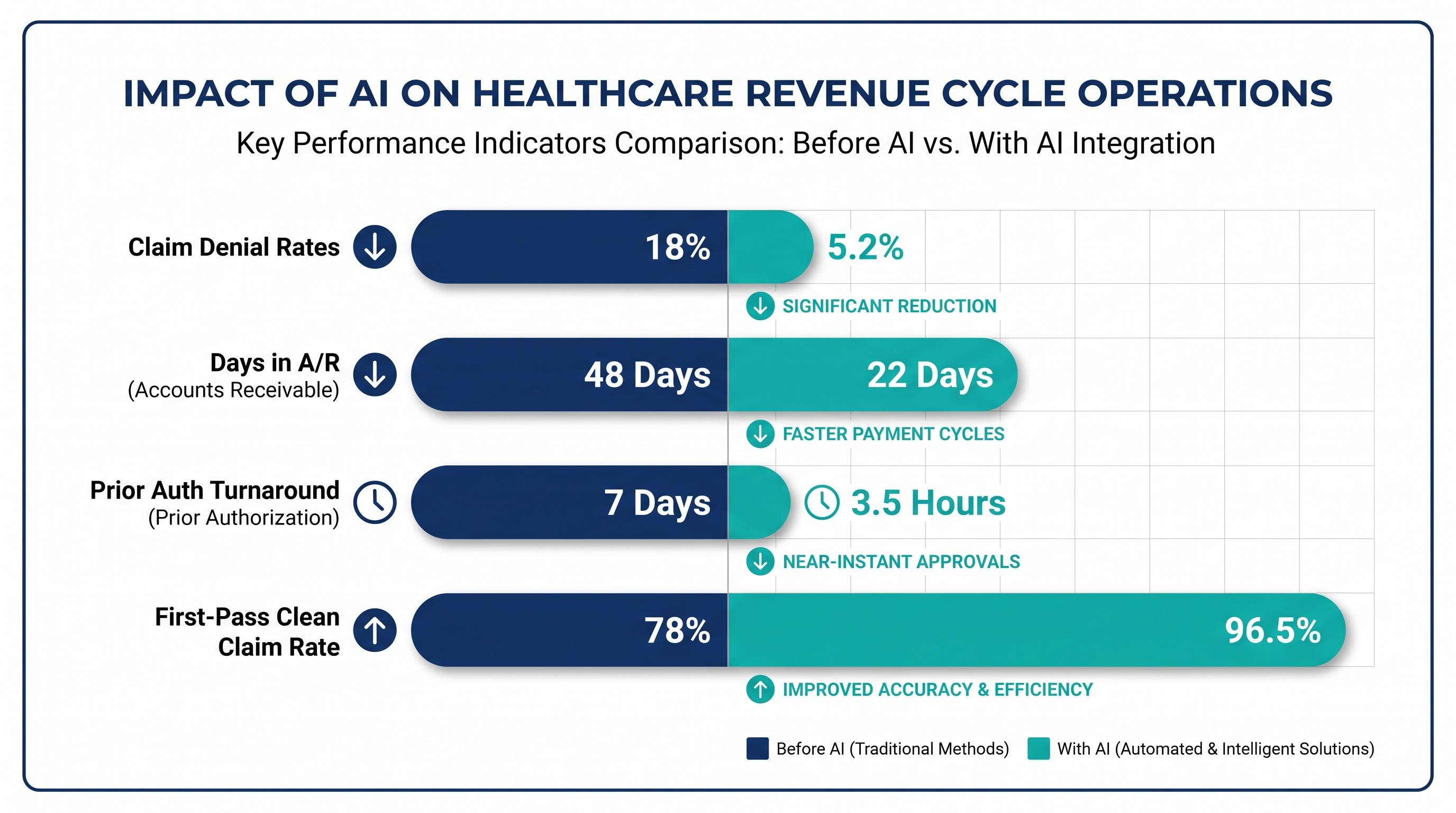
Enterprise benchmarks from health systems deploying AI RCM over 12 to 24 months:
- Claim denial rate reduced from 12.2% to 4.3% (65% reduction)
- Days in AR reduced from 52 to 31 days (40% improvement)
- Clean claim rate increased from 80% to 95%
- Coding productivity up 3.5x with 98.7% accuracy
- Prior auth turnaround: 3.2 days to 4 hours (92% reduction)
- Appeal success rate: 45% to 78%
- Revenue leakage from undercoding down 58%
For a 500-bed academic medical center with 1.2 billion USD in net patient revenue, these improvements translate to 47 to 68 million USD in annual incremental revenue capture.
HIPAA Compliance and Governance
All AI RCM pipelines enforce HIPAA Privacy and Security Rule requirements: minimum necessary access, BAA frameworks with AI vendors, AES-256 encryption for PHI at rest and in transit. For health systems subject to CMS MIPS requirements, AI coding accuracy directly impacts quality reporting scores.
Implementation Roadmap: 90 Days to First Results
Phase 1 (Weeks 1-4): Connect EHR, practice management system, and payer portals via HL7 FHIR R4. Establish denial rate, clean claim rate, and days-in-AR baselines.
Phase 2 (Weeks 5-10): Deploy real-time eligibility verification and autonomous coding. Target clean claim rate above 92 percent.
Phase 3 (Weeks 11-16): Activate AI denial classification and automated appeal workflows for the top 5 denial reason codes.
Phase 4 (Months 4-12): Integrate AI prior authorization with scheduling workflows. Establish 30-day rolling adjudication retraining cadence.
Conclusion
AI-powered revenue cycle management reframes RCM from a back-office cost center into a strategic revenue optimization engine. Health systems that deploy it in 2026 will carry compounding performance advantages for years. As reimbursement pressure intensifies and payer complexity grows, AI is no longer a competitive differentiator in healthcare RCM. It is becoming the baseline.
This article was written with AI assistance. La redaction de cet article a ete assistee par IA.