Gestion des Dépenses SaaS par IA : Réduisez les Coûts Logiciels de 35%
Par Delos Intelligence — 2026-08-20
Découvrez comment les responsables IT et FinOps utilisent des workers IA autonomes pour éliminer le shadow IT et optimiser les licences.
The Hidden Anatomy of Enterprise SaaS Waste
Enterprise software spend has evolved from centralized on-premise procurement into decentralized, credit-card-driven subscription sprawl. This friction creates four major structural vulnerabilities:
1. The Ghost License Epidemic: When employees transition roles or leave the company, deprovisioning workflows frequently miss secondary, add-on, or department-level SaaS seats.
2. Tier Mismatch and Over-Provisioning: Enterprises routinely purchase premium Enterprise tier licenses for users who only require basic read-only access.
3. Shadow IT and Redundant Tooling: Autonomous teams purchase overlapping point solutions across engineering, product, and marketing silos.
4. Auto-Renewal Traps: Vendor contracts with 60-day or 90-day written cancellation windows routinely auto-renew because manual tracking across spreadsheets fails to alert procurement in time.
!AI-Powered SaaS Spend Management Workflow
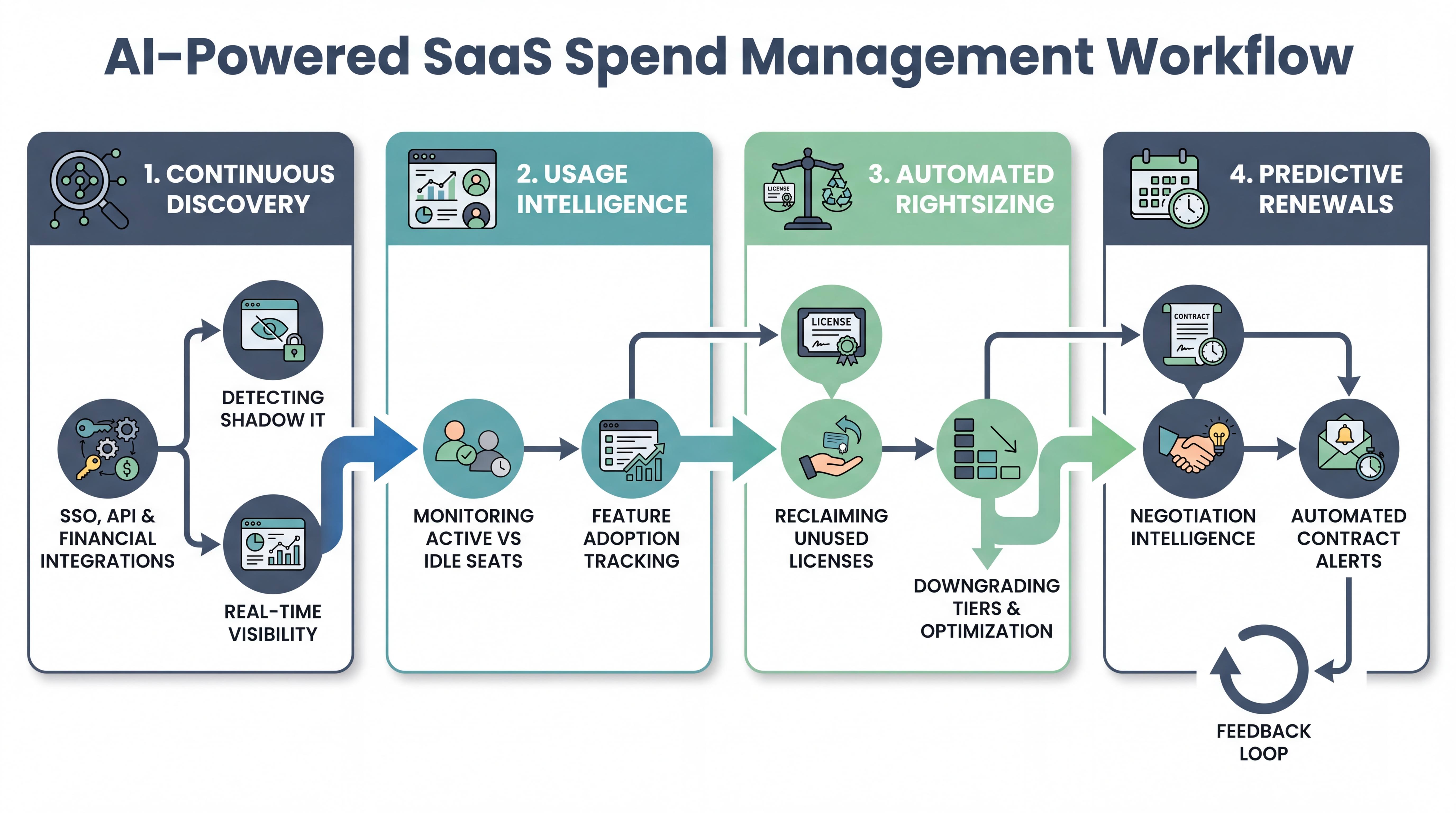
How Autonomous AI Workers Orchestrate SaaS Spend Optimization
Rather than waiting for manual audits, autonomous AI agents operate within the enterprise IT and FinOps infrastructure to execute closed-loop governance:
1. Continuous Multi-Source Discovery
AI workers establish unified visibility across the entire enterprise ecosystem:
- Identity and SSO Ingestion: Direct integration with Okta, Microsoft Entra ID, and Google Workspace.
- Financial and AP Transaction Auditing: Scanning ERPs (SAP, NetSuite, Coupa) and corporate card feeds.
- Deep API Telemetry: Hooking into direct vendor APIs (Salesforce, GitHub, Jira, Figma, Zoom, Slack).
2. Behavioral Utilization Intelligence
A login does not equal productive utilization. AI workers assess engagement depth:
- Identifying users who have not triggered a core action within 30, 60, or 90 days.
- Flagging departed or contractor accounts that retain active paid seats.
- Categorizing user personas to recommend immediate downgrades.
3. Automated Closed-Loop License Reclamation
When idle licenses are identified, AI workers autonomously orchestrate the reclamation workflow:
- Pinging the user via Slack, Teams, or email with a single-click verification prompt.
- Deprovisioning or reassigning the license if no response is received within a governance SLA.
- Maintaining an internal buffer pool of reclaimed licenses to instantly fulfill incoming new hire requests.
4. Predictive Vendor Renewal and Negotiation Intelligence
AI workers level the playing field by:
- Triggering automated renewal dossiers 90 days prior to contract deadlines.
- Modeling future seat requirements based on historical hiring velocity and actual peak utilization.
- Generating benchmarks against peer enterprise pricing curves for procurement negotiation leverage.
!Operational Impact of AI-Driven SaaS Spend Optimization
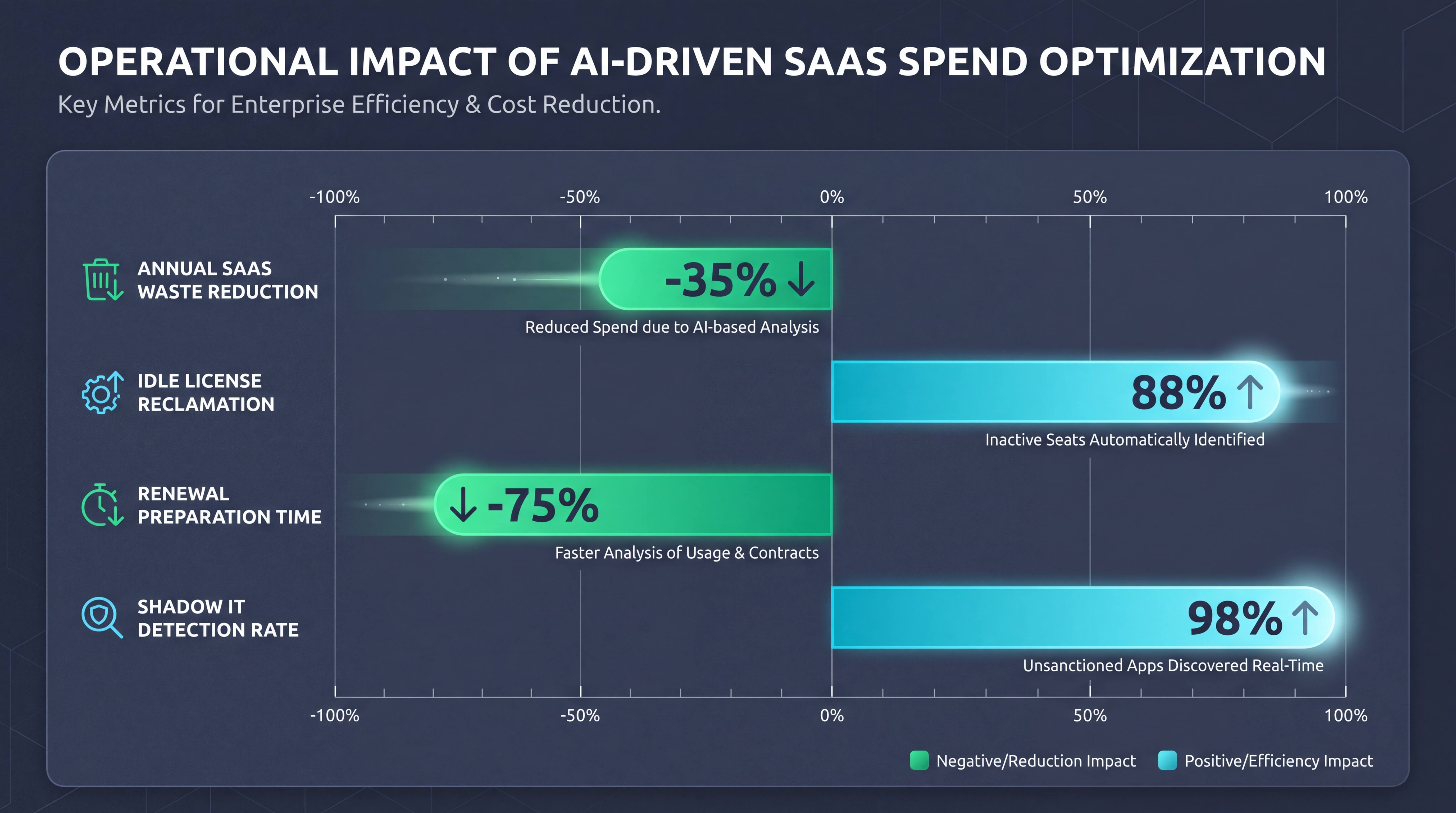
Measurable Operational and Financial Impact
| Metric | Traditional Manual ITAM | AI-Powered Autonomous ITAM | Enterprise Delta |
| :--- | :--- | :--- | :--- |
| Annual SaaS Spend Waste | 25-35% unmanaged | <5% residual | -30 to -35% Total Spend |
| Idle License Reclamation | 15% quarterly batch | 88% continuous | +73% Reclamation Rate |
| Renewal Preparation Time | 3-4 weeks per vendor | Instantaneous autonomous dossier | -75% Cycle Time |
| Shadow IT Detection | <40% discovered post-hoc | 98% within 24 hours | Eliminates Compliance Gaps |
Best Practices for Implementing AI-Driven SaaS Optimization
1. Unify the Telemetry Layer: Connect SSO, ERP expense feeds, and core SaaS APIs to establish a zero-blindspot data lake.
2. Define Dynamic Reclamation Thresholds: Configure sensible inactivity windows per department.
3. Empower Employees with Self-Service Guardrails: Pair AI deprovisioning with instant self-service re-activation.
4. Integrate with Procurement Workflows: Feed AI usage forecasts directly into vendor contract renegotiation cycles.
Conclusion
As software budgets face increased CFO scrutiny, passive SaaS dashboards are no longer sufficient. Autonomous AI workers provide continuous visibility, intelligent rightsizing, and proactive vendor intelligence to eliminate millions in software waste while strengthening organizational security. By shifting from reactive quarterly reviews to real-time autonomous governance, forward-thinking enterprises ensure every software dollar directly drives business productivity.
This article was written with AI assistance.