Inspection Visuelle par IA : Comment les Fabricants Eliminent les Defauts et Reduisent les Couts de Rebut de 45%
Par Delos Intelligence — 2026-08-17
Decouvrez comment la vision par ordinateur autonome et lintelligence de bord transforment le controle qualite industriel.
The Breaking Point of Manual Visual Inspection
On a modern discrete manufacturing line producing 1200 units per hour, human visual inspectors operate at peak capacity scanning for surface scratches. After 90 minutes of continuous inspection, detection accuracy falls below 75%. The scale challenge is fundamental: at line speed, each unit gets less than 50 milliseconds of human attention.
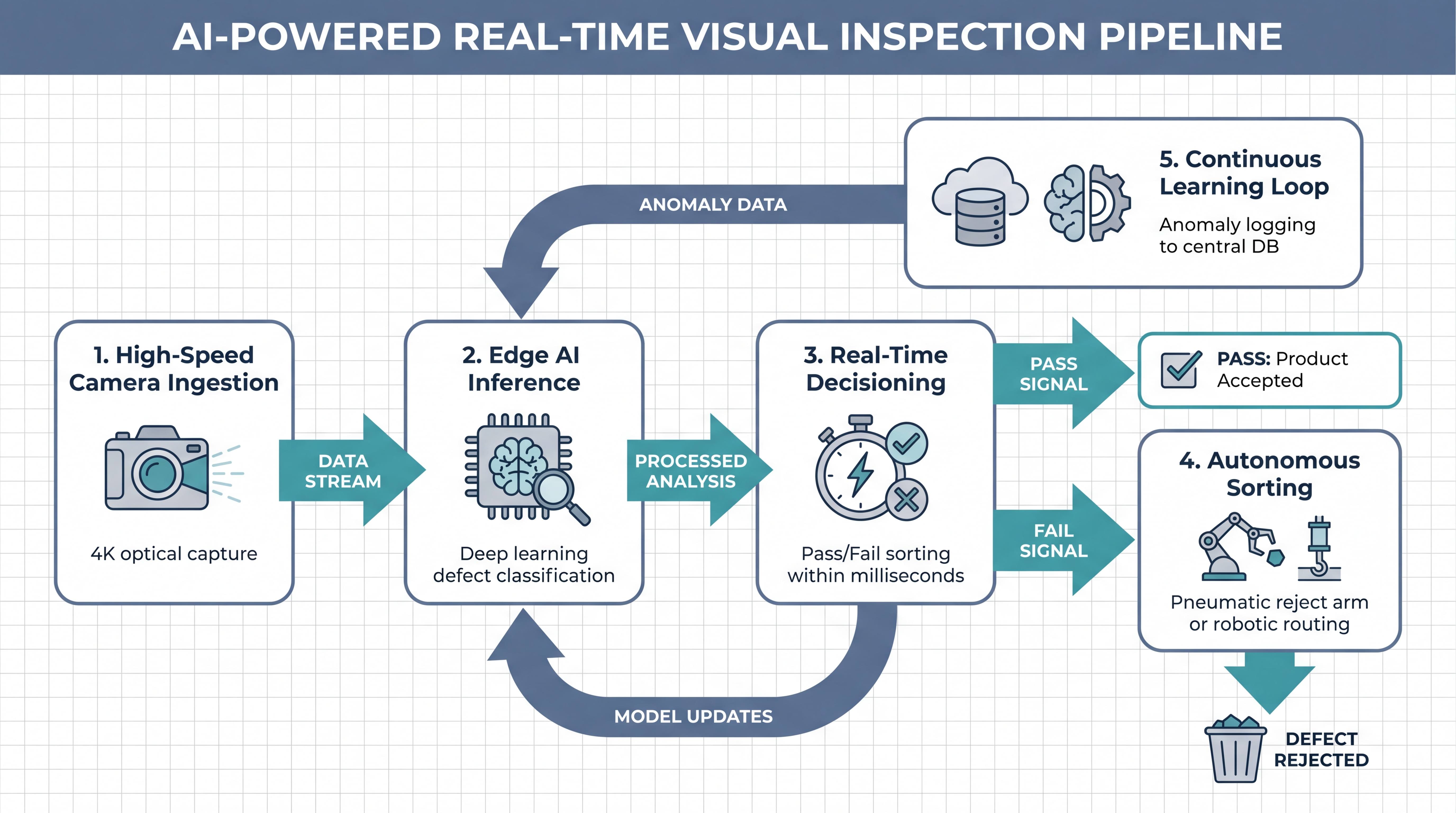
!AI-Powered Visual Inspection Architecture
How Edge AI Overcomes Human Perceptual Limits
Modern AI visual inspection deploys deep convolutional neural networks directly at the production line edge, processing high-resolution imagery in under 8 milliseconds per frame. Unlike cloud-dependent systems, edge inference operates at line speed with zero network latency.
Multi-Spectral Imaging Integration
Advanced deployments combine visible-light cameras with near-infrared, UV fluorescence, and X-ray systems. A single inspection station can simultaneously detect surface defects invisible to human eyes: micro-cracks 50 microns wide, sub-surface inclusions in castings, and coating thickness deviations of 2 microns.
Semantic Defect Segmentation
Unlike binary pass/fail classifiers, modern AI models perform pixel-level defect segmentation, classifying each anomaly by type (scratch vs. pit vs. porosity), severity (critical/major/minor), and location coordinates on the part. This granularity enables automated root-cause correlation with upstream process parameters.
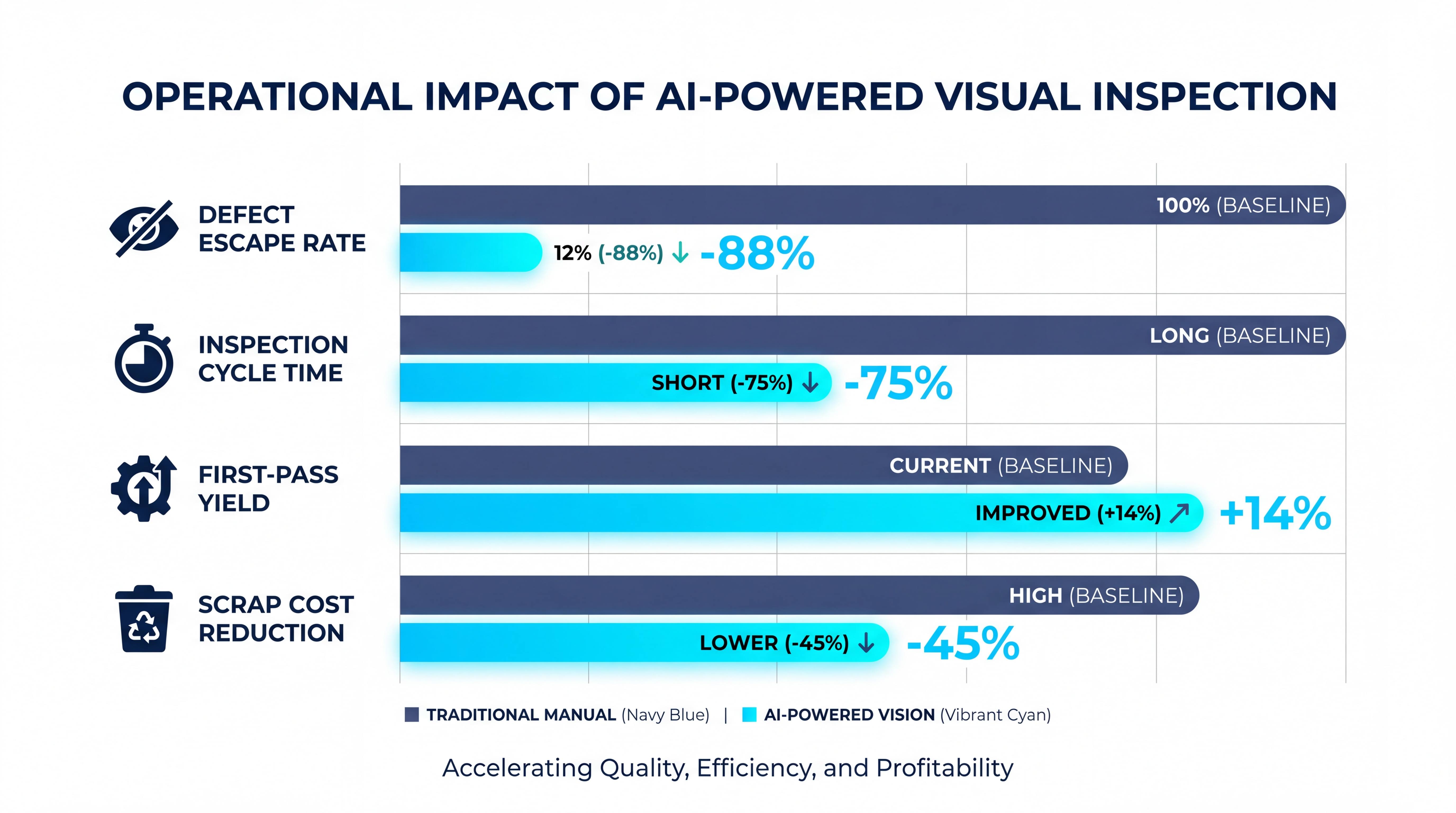
!Impact of AI Visual Inspection on Manufacturing Quality
Enterprise ROI Benchmarks
Manufacturers deploying AI visual inspection consistently achieve:
- 88% reduction in defect escapes reaching downstream assembly or end customers
- 45% reduction in scrap and rework costs through earlier defect interception
- First-pass yield improvements of 12-18 percentage points across high-volume production lines
- Inspection throughput 40-100x faster than human teams without accuracy degradation
- ROI payback periods of 9-14 months on average for Tier 1 automotive and electronics manufacturers
Integration with Robotic Automation
AI vision systems integrate directly with robotic arms for closed-loop quality control. When a defect is detected, the system triggers automated part rejection, logs the defect image and classification to the MES, and adjusts upstream process parameters in real time to prevent recurrence.
Implementation Roadmap
A phased deployment approach works best:
Phase 1 (Weeks 1-6): Pilot on a single high-defect product line. Collect labeled defect imagery (minimum 500 per class). Train initial model and validate against golden samples.
Phase 2 (Weeks 7-14): Deploy in parallel with human inspection. Build confidence through side-by-side comparison. Target 95%+ agreement rate before human removal.
Phase 3 (Weeks 15-20): Full autonomous deployment with human audit sampling (5-10%). Connect to MES and SPC systems. Enable real-time process feedback loops.
The Competitive Imperative
As automotive OEMs and electronics brands ratchet up supplier quality requirements, manual inspection is no longer sufficient. Zero-defect programs demand detection capabilities that only AI can deliver at production scale. Manufacturers that deploy AI visual inspection now build a quality foundation that enables them to win higher-value contracts and reduce warranty liabilities.