Optimisation du Besoin en Fonds de Roulement par IA : Comment les Entreprises Libèrent 50M€ de Trésorerie
Par Delos Intelligence — 2026-08-11
Les entreprises laissent des millions immobilisés. L IA réduit le DSO de 58%, étend le DPO de 12 jours et réduit les stocks de 35%, libérant 30-50M€ en 90 jours.
Why Working Capital Is the Hidden Crisis in Enterprise Finance
Working capital is the lifeblood of every enterprise. Yet most companies leave millions trapped in inefficient processes. Late customer payments, bloated inventory, and poorly timed supplier payments create a drag on liquidity that limits growth and increases borrowing costs.
According to a 2025 McKinsey study, the average large enterprise has 15 to 25% of its revenue tied up in excess working capital. For a company with $2 billion in revenue, that is $300 to $500 million sitting idle. AI-powered working capital optimization frees up cash trapped in receivables, payables, and inventory.
The Three Levers of Working Capital
Working capital optimization revolves around three core levers:
- Accounts Receivable (DSO): How fast you collect cash from customers
- Accounts Payable (DPO): How strategically you manage supplier payment terms
- Inventory (DIO): How efficiently you manage stock levels without stockouts
The Cash Conversion Cycle (CCC) = DSO + DIO - DPO. Every day shaved off the CCC frees up real cash. AI attacks all three levers simultaneously with predictive analytics, automated decision-making, and continuous optimization.
How AI Transforms Working Capital Management
Traditional working capital management is reactive. Finance teams review aging reports monthly, chase overdue invoices manually, and rely on gut-feel inventory decisions. AI flips this to a proactive, data-driven model.
1. Predictive Receivables: Cutting DSO by 58%
AI models analyze historical payment patterns, customer credit profiles, industry trends, and macroeconomic signals to predict which invoices will be paid late. This allows finance teams to intervene before a payment becomes overdue.
Leading enterprises using AI for receivables management have achieved:
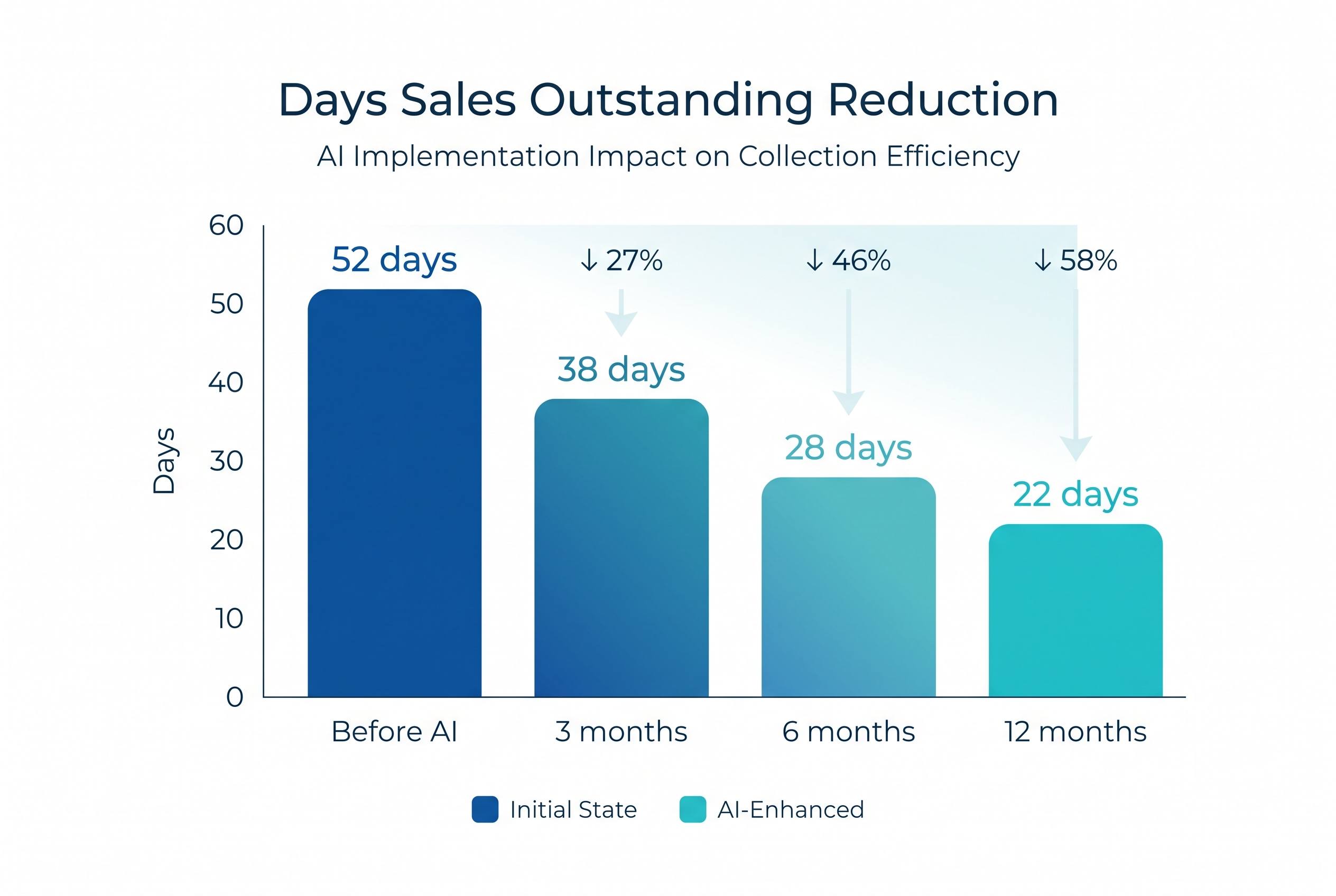
- 52% reduction in Days Sales Outstanding (DSO), from an average of 52 days to 22 days
- 40% fewer disputes through automated invoice matching and anomaly detection
- 3x faster collections through AI-prioritized dunning workflows
One Fortune 500 manufacturer implemented an AI-driven collections platform analyzing 2.3 million invoices across 8,000 customers. Within 12 months, DSO dropped from 54 to 23 days, freeing $180 million in cash. See also: AI demand forecasting.
!DSO Reduction with AI Working Capital Optimization
2. Intelligent Payables: Extending DPO Without Damaging Relationships
AI optimizes payment timing based on supplier relationships, early-payment discount opportunities, and cash position forecasts. The system identifies which invoices to pay early (capturing 1-2% discounts) and which to hold.
Key outcomes:
- 15-20% increase in captured early-payment discounts
- 8-12 day extension in average DPO without increasing supplier complaints
- Automated supplier segmentation protecting critical supply relationships
A global consumer goods company using AI captured $12 million in early-payment discounts annually while freeing $85 million in working capital.
3. Inventory Optimization: Reducing Carrying Costs by 35%
AI-driven AI inventory optimization combines demand forecasting, lead-time prediction, and safety stock calculation to maintain optimal stock levels.
Results:
- 35% reduction in inventory carrying costs
- 60% fewer stockouts on critical SKUs
- 20% reduction in excess and obsolete inventory
The AI Working Capital Optimization Stack
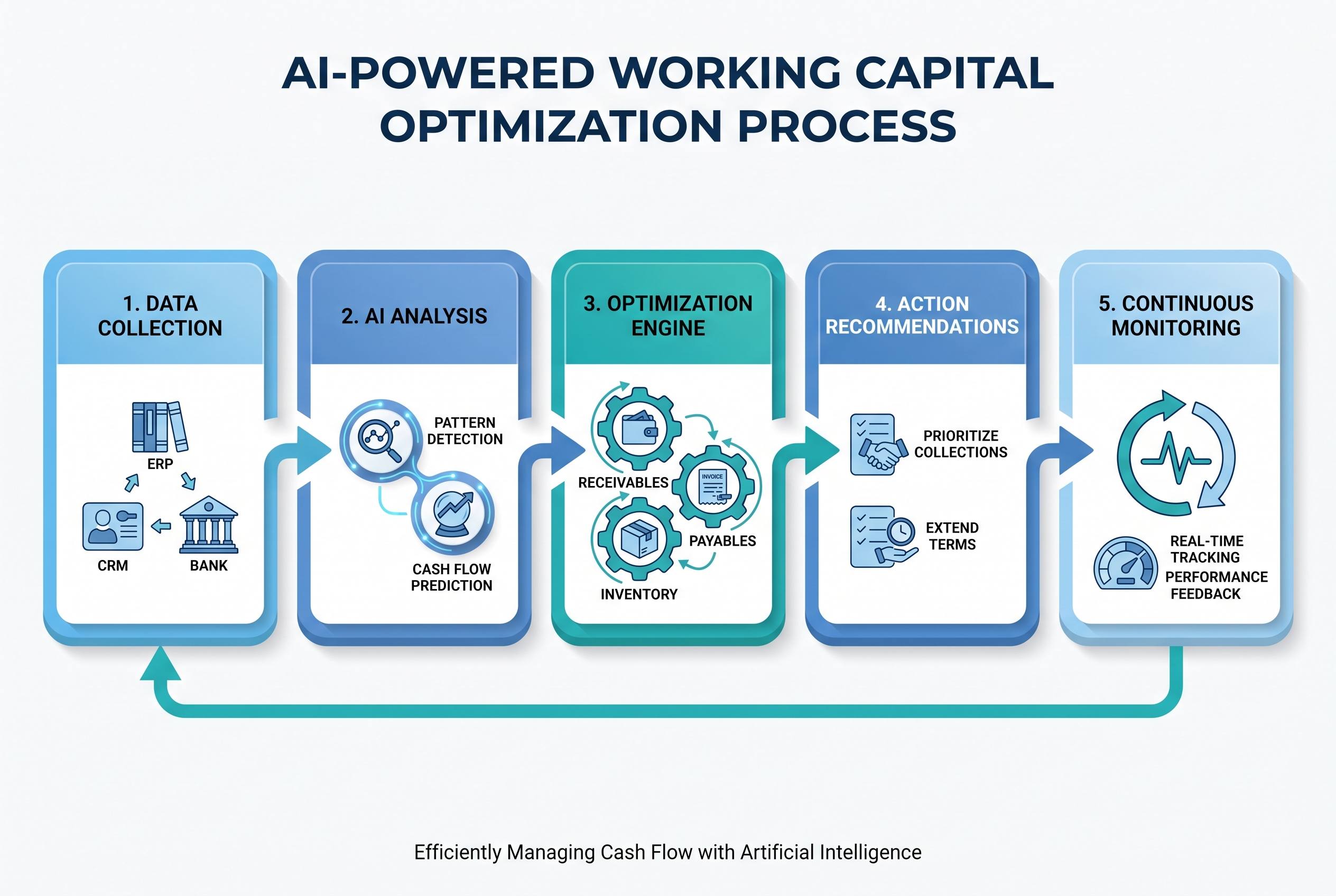
Modern AI working capital platforms integrate with ERP systems (SAP, Oracle, Microsoft Dynamics) and pull data from multiple sources:
- Data aggregation layer: Connects to ERP, CRM, bank feeds, and supplier portals in real time
- Predictive analytics engine: ML models that forecast cash flows and predict payment behavior
- Optimization engine: Algorithms that recommend specific actions for collections, payments, and reordering
- Automation layer: RPA and AI agents that execute recommendations and trigger payments
- Monitoring dashboard: Real-time visibility into CCC, DSO, DPO with scenario modeling
See also: AI treasury management.
!AI Working Capital Optimization Process Flowchart
Real-World Impact: A $50M Cash Release Case Study
A mid-sized industrial company with $1.2 billion in revenue implemented AI working capital optimization. Baseline: DSO of 58 days, DPO of 38 days, inventory turns of 4 per year.
After 12 months:
- DSO dropped from 58 to 24 days (59% reduction)
- DPO increased from 38 to 47 days (24% improvement)
- Inventory turns improved from 4 to 6.5 per year
- Cash Conversion Cycle compressed from 82 to 31 days
- Total cash freed: $52 million
The company redirected $30 million into a strategic acquisition and used the remainder to pay down debt, saving $4.2 million in annual interest costs.
Implementation Roadmap: 90 Days to First Results
Days 1-30: Data Integration and Baseline
Connect the AI platform to ERP, bank feeds, and CRM. Establish baseline metrics for DSO, DPO, DIO, and CCC. AI models begin training on historical payment and inventory data.
Days 31-60: Pilot Optimization
Run the optimization engine in recommendation mode for the top 20% of customers and suppliers. Typical early wins: $5-10M in immediately collectible overdue invoices and $3-5M in capturable early-payment discounts.
Days 61-90: Full Deployment and Automation
Switch to automated execution for high-confidence decisions. Deploy AI-driven dunning workflows, automated payment scheduling, and dynamic inventory reorder points. Most enterprises see DSO drop by 5-8 days in this phase alone.
Common Pitfalls and How to Avoid Them
- Data quality gaps: Ensure ERP data is clean and standardized before training models. Budget 2-3 weeks for data remediation.
- Resistance from collections teams: Frame AI as a tool that eliminates low-value chasing. Involve teams early in the pilot phase.
- Over-optimizing DPO: AI models should include supplier relationship scoring to balance payment timing with partnership health.
- Ignoring inventory interdependencies: Models must incorporate supply chain risk factors, not just demand forecasts.
The Future: Autonomous Working Capital Management
The next frontier is fully autonomous working capital management where AI agents monitor cash positions, predict shortfalls 30-60 days ahead, and automatically take corrective actions. McKinsey research shows enterprises with optimized working capital outperform peers by 15-20% in total shareholder return. Gartner predicts that by 2028, 40% of large enterprises will use AI agents for autonomous treasury management, up from less than 5% today. Learn more at delos.so.
Key Takeaways
- AI-powered working capital optimization frees up $30-50M in trapped cash for a typical mid-to-large enterprise
- All three levers (receivables, payables, inventory) can be optimized simultaneously with AI
- Implementation delivers measurable ROI within 90 days, faster than most enterprise AI initiatives
- The Cash Conversion Cycle can be compressed by 40-60%, dramatically improving liquidity
This article was written with AI assistance. La rédaction de cet article a été assistée par IA.