AIOps: How Enterprises Cut MTTR by 60% and Alert Noise by 90% in 2026
Par Delos Intelligence — 2026-07-31
The average IT team gets 500-1,200 alerts per day. AIOps cuts MTTR by 60%, alert noise by 90%, and auto-resolves 62% of infrastructure issues. Here's the 2026 enterprise implementation guide.
What AIOps Actually Does
The average enterprise IT team receives between 500 and 1,200 alerts per day. 58% of IT professionals struggle to interpret the ML outputs from their existing monitoring tools. Engineering toil has increased 30% since 2024 despite record investment in AI operations tools.
The contradiction is real: more tools, more alerts, more toil. AIOps exists to close that gap, and in 2026, the data shows it is finally working.
AIOps (Artificial Intelligence for IT Operations) applies machine learning, big data analytics, and intelligent event correlation to automate IT monitoring, anomaly detection, incident response, and root cause analysis. The term was coined by Gartner in 2017 to describe platforms that combine historical and real-time data from multiple IT tools, apply ML models to surface actionable insights, and trigger automated remediation workflows.
The practical result: IT teams spend less time manually correlating log data and more time on strategic work.
Traditional Monitoring vs AIOps
| Dimension | Traditional Monitoring | AIOps |
|---|---|---|
| Detection | Predefined thresholds, manually set | ML-based anomaly detection, no thresholds needed |
| Alert handling | Every event generates an alert | Intelligent correlation groups and deduplicates alerts |
| Root cause analysis | Manual log correlation across tools | Automated cross-system event correlation |
| Response | Reactive, after user reports | Proactive, predicts failures up to 72 hours ahead |
| Alert volume | 500-1,200 per day | 80-90% reduction through event correlation |
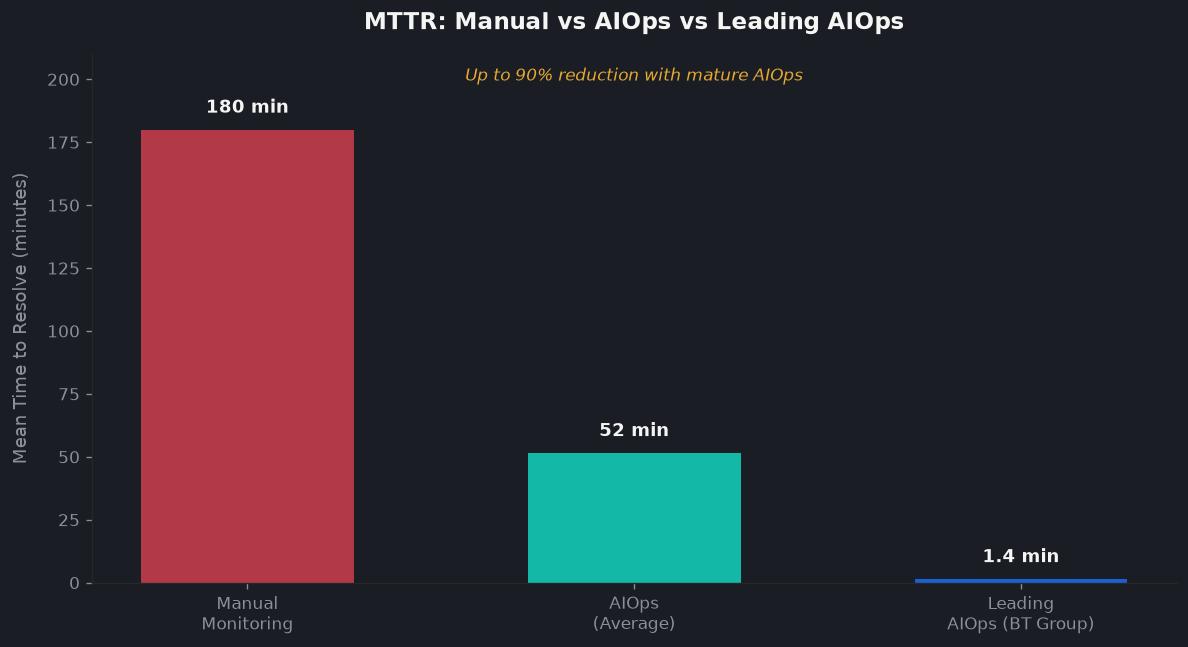
| MTTR | Hours to days | 40-60% reduction, up to 96% in best cases |
!Traditional monitoring vs AIOps comparison
The Numbers That Matter in 2026
The AIOps platform market reached $2.67 billion in 2026, growing to $11.8 billion by 2034 at a 20.4% CAGR (Fortune Business Insights). But the operational metrics tell the real story:
- 40-60% MTTR improvement across enterprise AIOps deployments (OpenObserve research)
- 80-90% alert volume reduction through intelligent event correlation
- 73% improvement in mean time to detect (MTTD) (ResearchGate)
- 62% of common infrastructure issues auto-resolved without human intervention in mature deployments
- 47% reduction in SRE on-call burden (DevOps.com)
- $3.70 return per dollar invested in AI operations tools (LogicMonitor)
- 70% of automation adopters see ROI within 12 months
BT Group cut their MTTR from 2 hours to 85 seconds, a 96% reduction, by deploying AIOps for incident response. That is not incremental improvement. That is a paradigm shift.
The Five Capabilities That Define AIOps
!Five core capabilities of AIOps platforms
1. Intelligent Event Correlation
The average IT team receives 500-1,200 alerts per day. Most are noise: duplicate alerts from different monitoring tools, cascading alerts from a single root cause, or low-priority events that do not require action.
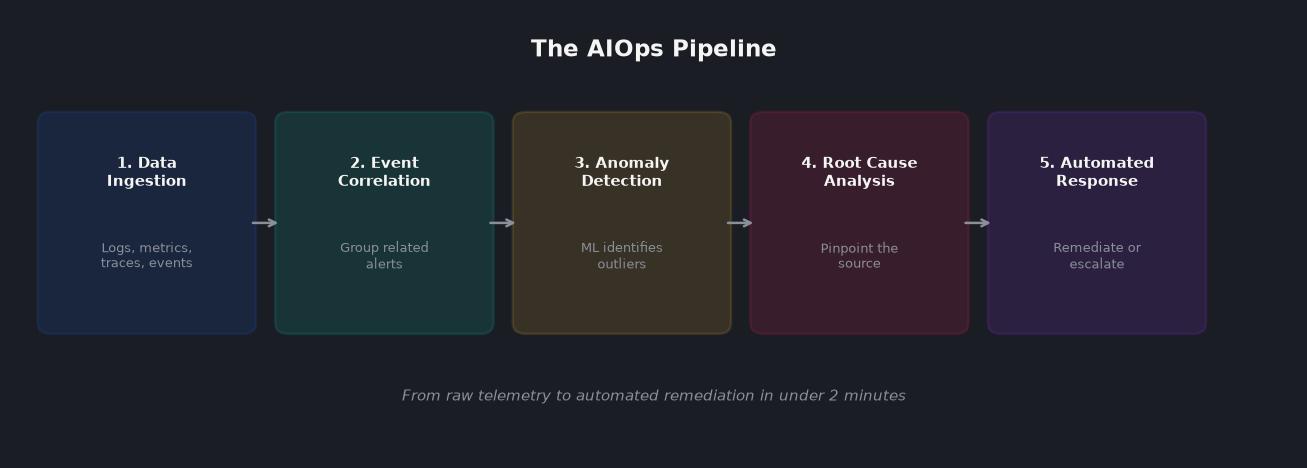
AIOps platforms ingest telemetry from all monitoring tools, correlate events across systems, and group related alerts into single incidents. The result: 80-90% alert volume reduction. On-call engineers stop drowning in noise and start focusing on actual incidents.
2. ML-Powered Anomaly Detection
Traditional monitoring relies on predefined thresholds: CPU above 80%, latency above 200ms, error rate above 1%. These thresholds are static, manually maintained, and often wrong. They either alert too late (the threshold was set too high) or cry wolf (the threshold was set too low).
AIOps uses machine learning to learn the normal behavior patterns of every system, service, and metric. It detects anomalies automatically, without predefined thresholds, and adapts as systems evolve. No more tuning thresholds at 2am.
3. Predictive Incident Management
AIOps platforms can predict server failures up to 72 hours before occurrence (LogicMonitor). By analyzing patterns across logs, metrics, and traces, AI identifies early warning signs of system degradation before users report issues.
One enterprise reduced their mean time to detect (MTTD) from 45 minutes to 3 minutes by deploying AI anomaly detection across their infrastructure monitoring stack. They resolved 23% of incidents before a single user noticed.
4. Automated Root Cause Analysis
When an incident occurs, engineers spend hours manually correlating logs, metrics, and events across multiple tools to find the root cause. AIOps automates this correlation, ingesting telemetry from all monitoring tools and surfacing the likely root cause in seconds.
Incident investigation time drops by 70-90% when AIOps handles root cause analysis. What used to take 3 hours of manual log diving now takes 3 minutes of AI-assisted correlation.
5. Self-Healing Infrastructure
In mature AIOps deployments, 62% of common infrastructure issues are auto-resolved without human intervention. The AIOps platform detects the issue, identifies the remediation step from a playbook of pre-approved actions, executes it, and verifies the fix.
This is not science fiction. It is the documented state of AIOps in 2026 for organizations that have invested in mature deployments.
Why 63% of Enterprises Still Struggle
Despite the clear ROI, most enterprises are not there yet. 63% of organizations report a shortage of professionals skilled in AI-driven IT operations. The barriers fall into four categories:
1. Tool sprawl without integration. The average enterprise uses 15-25 monitoring tools. Each generates its own alerts, its own dashboards, its own data silos. AIOps requires ingesting telemetry from all of them, which means integration work that most teams postpone indefinitely.
2. Alert fatigue as a cultural problem. When teams receive 1,000 alerts per day, they develop alert blindness. They mute notifications, ignore pages, and miss real incidents. AIOps solves this technically (80-90% alert reduction), but the cultural damage takes longer to repair. Teams need to rebuild trust in their alerting system.
3. Skills gap. 58% of IT professionals struggle to interpret ML outputs from AIOps platforms. The tools generate insights, but the team cannot act on them. Training is not optional. It is a prerequisite for AIOps success.
4. Fear of automation. IT teams worry that automated remediation will make things worse, not better. The fear is not unfounded: poorly configured auto-remediation can cascade failures. The solution is starting with read-only AIOps (detection and recommendation only) before enabling automated actions.
The Implementation Roadmap
!AIOps implementation roadmap timeline

Phase 1: Assess and Baseline (Weeks 1-4)
- Audit your current alert volume, MTTR, MTTD, and on-call burden
- Identify your top 5 most common incident types
- Map your monitoring tool stack and data sources
- Establish baseline metrics for all KPIs
Phase 2: Deploy AIOps for Incident Detection (Months 1-3)
- Select an AIOps platform that integrates with your existing monitoring stack
- Connect all telemetry sources (logs, metrics, traces, events)
- Enable ML-powered anomaly detection in read-only mode
- Measure MTTD improvement and alert volume reduction
Phase 3: Intelligent Alert Correlation (Months 1-4)
- Configure event correlation rules to group related alerts
- Target 80% alert volume reduction within 60 days
- Set up unified incident views that show correlated events across systems
- Measure on-call burden reduction
Phase 4: Predictive and Proactive (Months 3-6)
- Enable predictive analytics for your top 5 incident types
- Configure proactive alerting for predicted failures
- Set up automated remediation playbooks for the top 3 most common issues
- Measure MTTR improvement and auto-resolution rate
Phase 5: Self-Healing and Autonomous Operations (Months 6-12)
- Expand automated remediation to more incident categories
- Implement continuous learning from resolution data
- Move toward AI-acts, human-audits model (only 12% of organizations are here today)
- Measure overall operational autonomy and cost savings
The ROI Is Not Subtle
Organizations with fully integrated AI operations are 4x more likely to report revenue growth (58% vs 15%) compared to organizations not using AI in operations (PagerDuty 2026). The difference is not just technology. It is accountability, governance, and the willingness to redesign workflows around AI rather than adding AI to existing processes.
48% of organizations add AI without redesigning their workflows. These organizations see minimal gains. The organizations that reinvent their operations around AI capabilities report 10-25% EBITDA improvements (Bain 2026).
The cost of inaction is quantifiable: 67% of organizations lose more than $300,000 per hour of downtime. Every month without AIOps, you are burning money on reactive incident response, alert fatigue, and manual root cause analysis that AI can do in seconds.
The Bottom Line
AIOps in 2026 is not a future technology. It is a present-day competitive advantage. The market data, the case studies, and the ROI metrics all point in the same direction. The question is not whether AIOps will become the standard for enterprise IT operations. It is whether you will be among the organizations that capture the advantage early, or among the 63% still struggling with alert fatigue and manual toil in 2027.
Start with incident management. Reduce alert noise first. Prove the ROI in 90 days. Then expand.