Maintenance Prédictive IA : Comment les Entreprises Réduisent les Pannes de 70% avec l'IoT
Par Delos Intelligence — 2026-08-06
Unplanned equipment failure costs enterprises $50B annually. AI-powered predictive maintenance combines IoT sensors with machine learning to cut downtime by 70%, reduce maintenance costs by 25%, and extend asset lifespan by 20-40%. Here is how it works and how to implement it.
Why Predictive Maintenance Is the Next Enterprise Frontier
Unplanned equipment failure costs enterprises an average of $50 billion annually. For manufacturing alone, a single hour of downtime can cost up to $260,000. Yet most organizations still rely on reactive maintenance, or preventive maintenance on a fixed schedule regardless of actual condition.
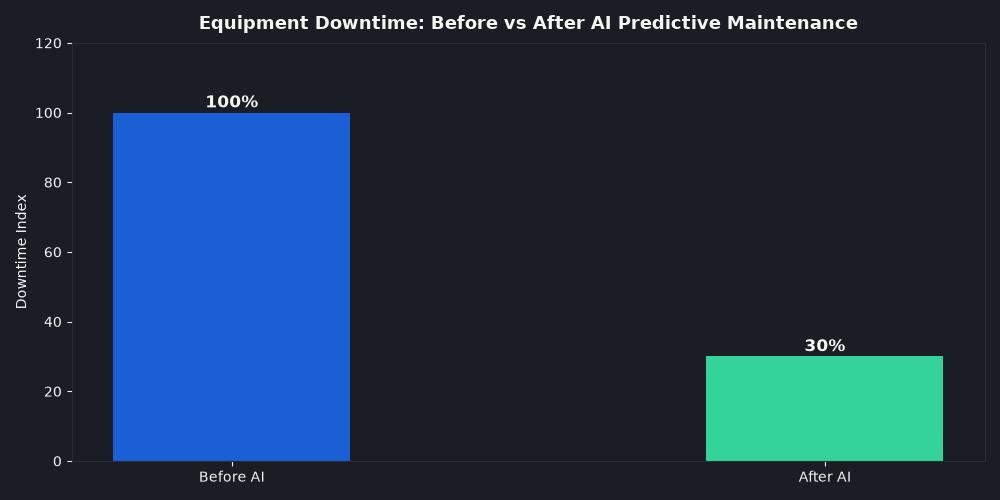
AI-powered predictive maintenance changes the equation. By combining IoT sensor data with machine learning models, enterprises can predict failures before they happen, schedule maintenance at the optimal time, and extend asset lifespan by 20-40%. The result: downtime cut by 70%, maintenance costs reduced by 25%, and a dramatic shift from firefighting to proactive operations.
!Equipment Downtime: Before vs After AI Predictive Maintenance
How AI Predictive Maintenance Works
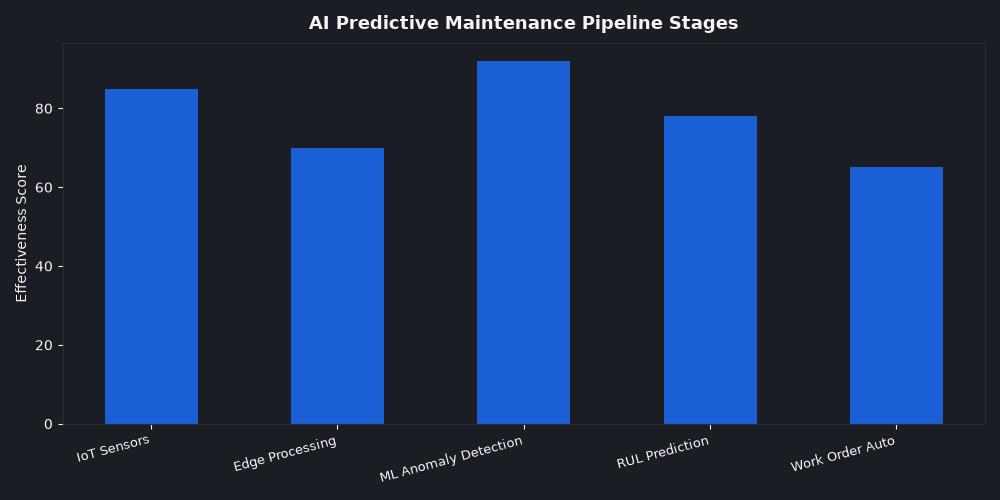
The core of predictive maintenance is a data pipeline that continuously monitors equipment health and flags anomalies before they become failures.
1. Sensor Data Collection
IoT sensors mounted on equipment capture real-time data: vibration, temperature, pressure, acoustic emissions, and electrical current. A single industrial motor might produce 500 data points per second across 6 sensor types. Modern edge gateways preprocess this data locally, filtering noise and reducing transmission volume by 80% before sending it to the cloud.
2. AI Anomaly Detection
Machine learning models analyze the sensor stream for patterns that precede breakdowns. The most common approach uses supervised classification (identifying known failure modes) and unsupervised anomaly detection (catching novel patterns). Models like isolation forests, autoencoders, and LSTM neural networks are industry standards for time-series anomaly detection.
3. Failure Prediction
Once an anomaly is detected, the system estimates the remaining useful life (RUL) of the component. Instead of a binary alert, the model outputs a probability distribution over time: the component has a 78% chance of failing within the next 14 days, giving the team a clear, actionable window.
4. Automated Work Order Generation
The prediction triggers an automated workflow: a work order is created in the CMMS, parts are checked for availability, and a technician is scheduled. The entire process, from anomaly detection to work order creation, takes under 5 minutes, compared to days or weeks in a reactive model.
!AI Predictive Maintenance Pipeline Stages
The Business Case: By the Numbers
Enterprises that have implemented AI predictive maintenance report consistent, measurable outcomes:
- Downtime reduction: 70% average decrease in unplanned downtime, with some manufacturers reporting up to 90% for critical assets
- Maintenance cost savings: 25-30% reduction in total maintenance spend, driven by fewer emergency repairs and optimized part inventory
- Asset lifespan extension: 20-40% longer equipment life, as components are replaced before catastrophic failure damages surrounding systems
- Safety improvement: 35% reduction in safety incidents related to equipment failure
- ROI timeline: Most implementations achieve positive ROI within 12-18 months, with payback periods as short as 6 months for high-value assets
For context on AI-powered asset management and broader AI risk management frameworks, the predictive maintenance discipline sits at the intersection of both domains. See also McKinsey on predictive maintenance in smart factories and Deloitte on IoT predictive maintenance for independent benchmarks.
Real-World Implementation: A Manufacturing Case Study
A European automotive parts manufacturer deployed AI predictive maintenance across 1,200 machines in 3 plants. Before implementation, the company averaged 42 hours of unplanned downtime per month, costing an estimated $1.1M per plant annually.
The implementation took 8 months and involved installing 4,800 IoT sensors across 1,200 machines, training ML models on 3 years of historical maintenance logs, integrating predictions with their existing SAP CMMS, and training 45 maintenance technicians on the new workflow.
After 12 months in production: unplanned downtime dropped to 12 hours per month (71% reduction), maintenance costs fell by 28%, and the company saved an estimated $2.3M across the three plants. The initial investment of $1.8M was recovered in under 10 months.
Getting Started: A Practical Roadmap
Phase 1: Identify High-Impact Assets (Weeks 1-4)
Prioritize assets where failure has the highest business impact: critical production lines, expensive-to-replace equipment, and machines with a history of unplanned downtime. A good starting point is the top 10% of assets by criticality. NIST manufacturing data standards provide a useful framework for asset criticality classification.
Phase 2: Instrument and Collect Data (Weeks 5-12)
Install IoT sensors on the selected assets and begin collecting baseline data. You need at least 3-6 months of historical data to train meaningful models, though combining existing maintenance logs with new sensor data can accelerate this.
Phase 3: Build and Train Models (Weeks 13-20)
Start simple with threshold-based alerts and evolve to ML-based predictions as your dataset grows. Validate models against known failure events before deploying to production. AI cost optimization principles apply here: start small, prove ROI, then scale.
Phase 4: Integrate and Scale (Weeks 21-32)
Connect predictions to your CMMS, establish the automated work order workflow, and train your maintenance team. Once the pilot proves ROI, expand to the next tier of assets. Most enterprises reach full coverage within 18-24 months.
Common Pitfalls to Avoid
- Data quality issues: Sensor data is only as good as its calibration. Dirty, misaligned, or poorly placed sensors produce noise that models misinterpret.
- Over-reliance on models: AI predictions are probabilistic, not certain. Always pair model output with technician expertise.
- Integration gaps: If predictions do not flow into the CMMS and trigger action, they are just dashboards. The value is in the closed loop: detect, predict, act, verify.
- Scaling too fast: Starting with 500 machines instead of 50 means you spread your data science resources thin. Prove the model on a small set, then scale.
The Future: From Predictive to Prescriptive
Prescriptive maintenance recommends the optimal maintenance action, not just when something will fail. Should you replace the bearing now, or run it for 3 more weeks and schedule the repair during the next planned outage? These systems factor in production schedules, parts availability, and cost trade-offs. Early adopters report an additional 15-20% savings on top of predictive maintenance.
Key Takeaways
- AI predictive maintenance reduces unplanned downtime by 70% and maintenance costs by 25%
- The technology stack combines IoT sensors, edge processing, ML models, and CMMS integration
- Start with a focused pilot on high-impact assets, prove ROI, then scale
- Most implementations pay back within 12-18 months
- The next frontier is prescriptive maintenance, which optimizes not just timing but the maintenance action itself
La rédaction de cet article a été assistée par IA.